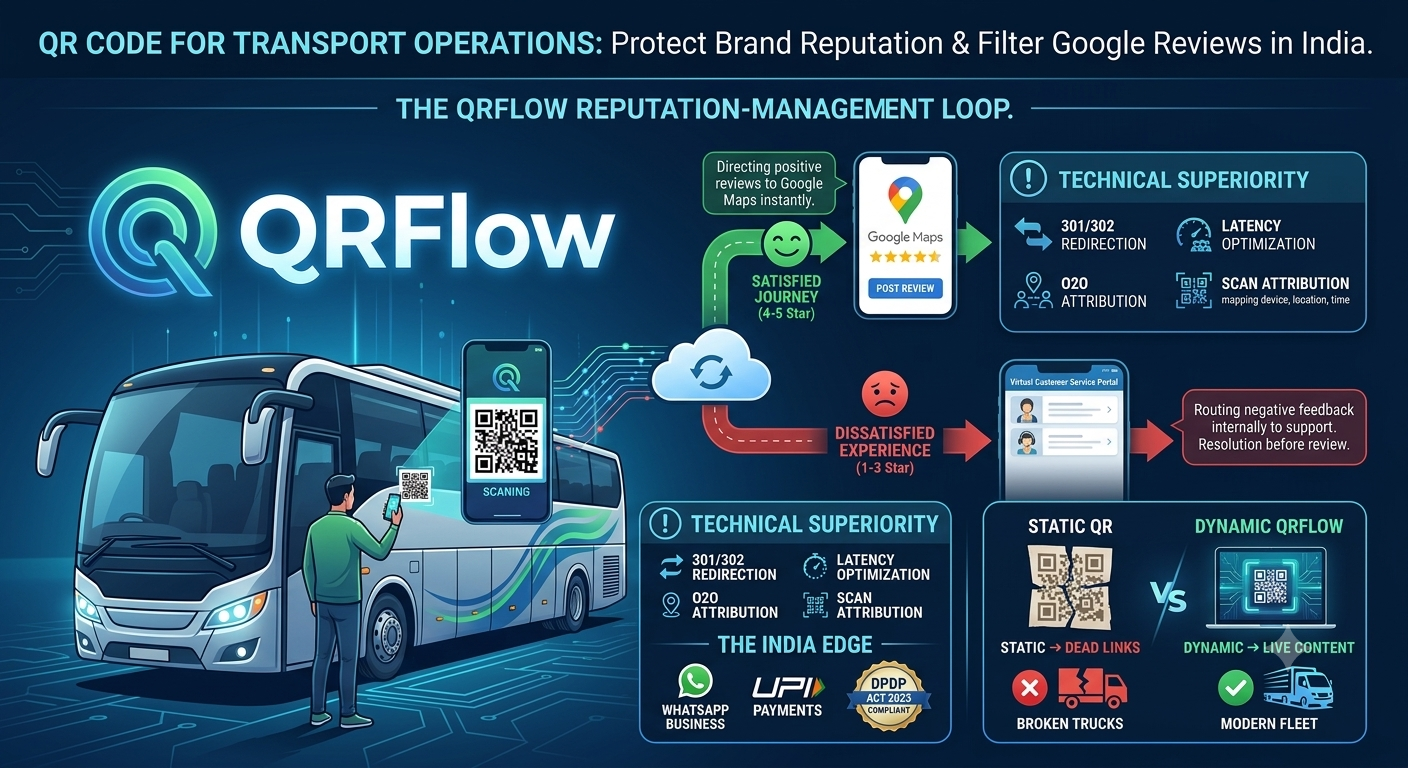
In the hyper-competitive Indian transport and logistics landscape—spanning interstate private bus fleets, app-based cab aggregators, corporate employee transits, and luxury self-drive rentals—reputation is the primary driver of customer acquisition. A single-star drop on Google Maps or TripAdvisor can immediately decimate booking volumes by up to 35%.
The fundamental challenge of physical, in-vehicle marketing is its static nature. Thousands of physical assets (seatback stickers, luggage tags, driver dashboards, window decals) are printed and distributed across vast geographical regions. If a URL breaks, a feedback link changes, or a review campaign shifts focus, businesses face the astronomical expense of re-printing and re-distributing physical collateral.
Even worse, placing a direct, unmanaged link to a Google Business Profile inside a vehicle invites unmoderated public venting. If a passenger experiences a delayed AC coach or a rude driver encounter, their immediate impulse is to scan the code and broadcast their frustration to the world.
This is where Phygital Marketing meets proactive reputation management. By switching from rigid, unalterable URLs to enterprise-grade managed redirects, Indian transport operators can turn every vehicle into an intelligent feedback loop that protects the brand’s digital footprint.
The Strategic Divide: Static vs. QRFlow Dynamic Architecture
Understanding the foundational network mechanics of how QR codes handle data is critical before deploying them across hundreds of vehicles.
A static QR code encodes the destination URL directly into its matrix pattern. Once printed, it cannot be modified. If the URL breaks, the code becomes a permanent "Dead Link."
Conversely, QRFlow Dynamic QR codes act as lightweight, high-speed pointers. The physical pattern contains a short, optimized URL pointing to the QRFlow secure routing engine, which executes a server-side redirect to the intended destination instantly.
| Technical Attribute | Static QR Codes | QRFlow Dynamic Framework | Business & Operational Impact |
|---|---|---|---|
| URL Flexibility | Hardcoded. Permanent after printing. | Real-time destination updates via 301/302 Redirection. | Zero re-printing costs if target links change or campaigns end. |
| Scan Attribution | Non-existent. Counts as generic direct traffic. | Advanced Scan Attribution (Time, Date, Device, Location). | Granular tracking of passenger engagement per vehicle, route, or city. |
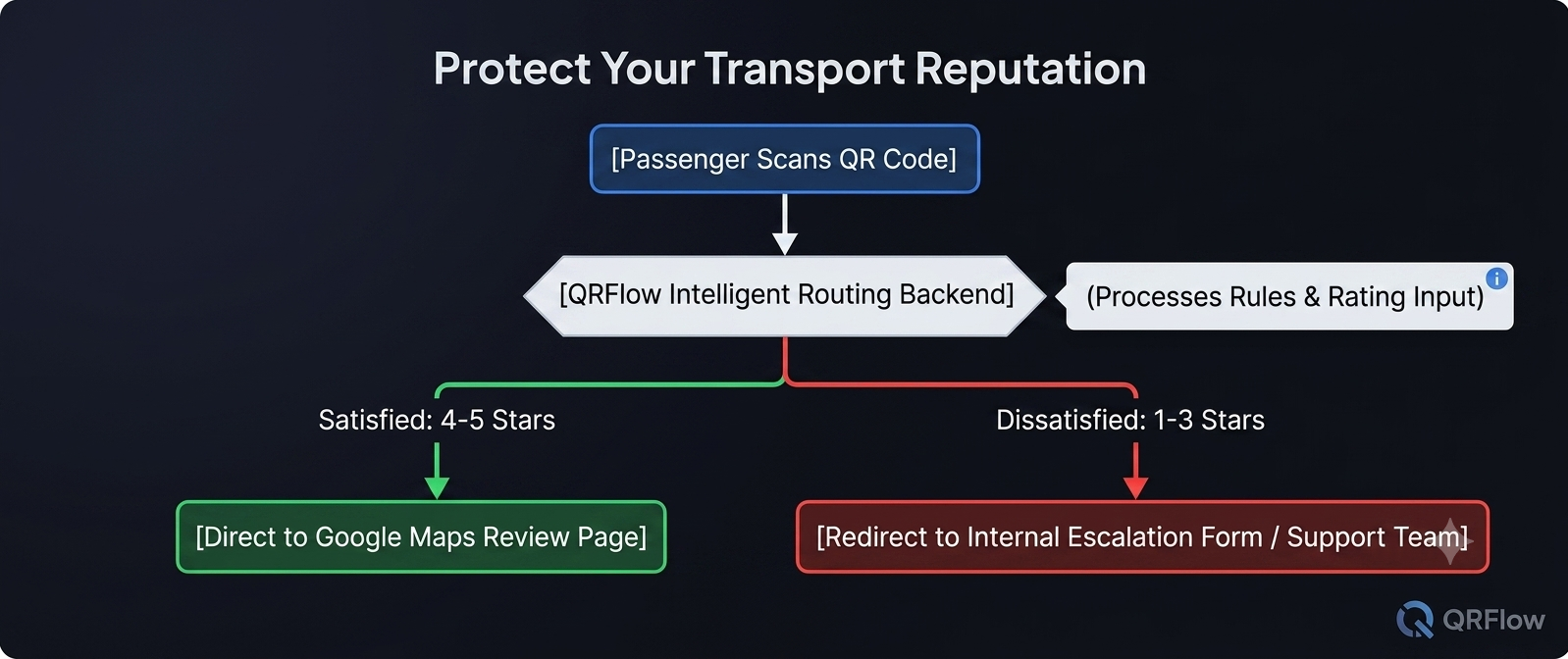
| Routing Intelligence | Single destination for all users. | Dynamic conditional logic based on inputs or user choices. | Filters 1-3 star ratings to internal support; routes 4-5 stars to Google Maps. |
| Data Matrix Density | Complex, dense pattern. Harder to scan in low light. | Short URL structure. Clean, low-density vector graphic. | Rapid scans even inside moving vehicles or under poor interior lighting. |
| Security & Compliance | Vulnerable to malicious domain hijacking if origin fails. | Enterprise-grade encryption, managed routing, fully DPDP Compliant. | Absolute protection against link rot, physical tampering, and data breaches. |
To leverage this intelligent infrastructure across your fleet, you can initiate deployment instantly by visiting the QRFlow Sign Up Portal.
High-Impact Use Cases for Indian Transit & Fleet Operations
1. The Intelligent Reputation Filter: Intercepting Low Ratings In-Transit
Deploy seatback decals featuring a clear call-to-action: "Rate Your Journey & Win Cashback/Travel Vouchers."
When a passenger scans the code, they land on a localized mobile interface that asks for a quick star rating. If the user selects 4 or 5 stars, the QRFlow backend executes an instantaneous 302 Redirection straight to the company's verified Google Maps listing, pre-filling the positive sentiment while the experience is fresh.
If the user selects 1, 2, or 3 stars, the platform instantly pivots, routing the passenger to an internal high-priority complaints portal or opening an automated WhatsApp Business chat. The customer vents internally, customer support receives the live vehicle details via custom URL parameters, and the public Google Maps rating remains completely protected from a damaging negative review.
2. O2O Attribution for Intercity Luxury Bus Fleets
For private operators running multi-state routes (e.g., Mumbai to Goa, Bangalore to Hyderabad), understanding which physical routes yield the highest digital engagement has historically been impossible.
By mapping unique dynamic codes to specific vehicle registration numbers or route blocks, marketing teams can achieve pristine O2O (Online-to-Offline) Attribution. The dashboard tracks exactly which routes generate the highest feedback volumes, allowing management to correlate passenger satisfaction with specific driver shifts, onboard amenities, or regional road conditions.
3. Direct WhatsApp Business Integration for Instant Grievance Redressal
In India, email is rarely the preferred channel for real-time customer support. Passengers expect instant resolutions.
By embedding deeply linked WhatsApp triggers within the dynamic framework, scanning the dashboard or seatback code opens a pre-populated chat thread: "Hi [Operator Name], I am traveling on Bus NI-4022 and need assistance with the AC/Seating." This bypasses friction entirely, routing the passenger directly to an automated chat menu or a live support agent before their discomfort turns into a public social media complaint.
4. Seamless UPI Payment Flows for Onboard Upgrades & Amenities
For luxury coaches, sleeper buses, or corporate shuttles offering paid add-ons (such as gourmet meals, premium blankets, or Wi-Fi packages), physical friction kills conversions.
Dynamic codes can be configured to point directly to unified UPI payment strings (upi://pay?pa=merchant@vpa&pn=Operator...). Passengers scan the code on their window, their preferred banking app (GPay, PhonePe, Paytm) opens instantly with the exact amount pre-filled, and the transaction completes securely in seconds.
5. Smart Luggage Tags with Dynamic Contact Routing
Lost luggage is a logistical nightmare that frequently translates into scathing 1-star reviews.
By provisioning unique dynamic tags attached to passenger baggage at check-in, operators provide a secure communication bridge. If a bag goes missing or is picked up by the wrong passenger, the finder scans the tag. Instead of exposing the passenger’s private phone number—which violates modern data privacy standards—the code routes the finder to a secure intermediary portal where they can contact the operator's baggage desk or securely text the owner.
Technical Superiority: Why Free Engines Threaten Brand Security
Many businesses fall into the trap of using free, ad-supported online generators for their operations. In an enterprise environment, this introduces critical points of failure.
Latency Optimization & The Critical Window
In moving vehicles, network connectivity fluctuates wildly across Indian highways and tier-2 corridors. A free generator often routes traffic through cheap, unoptimized international servers, introducing 3 to 5 seconds of latency before the target page even begins to load. If a page doesn't load within 2 seconds, 53% of mobile users abandon it.
The core architecture of QRFlow Features is built entirely on edge-computing routing nodes optimized for the Indian subcontinent. By slashing lookups down to sub-millisecond ranges, the platform ensures that even on a weak 3G/4G signal along a remote highway, the redirect occurs almost instantly.
Deep Analytics & Edge Fingerprinting
Free tools provide simple, inaccurate hit counters that are frequently inflated by search engine crawlers and scraping bots. Enterprise infrastructure requires deep, actionable intelligence. The backend captures comprehensive, non-invasive metrics including:
- Device & OS Architecture: Distinguishing between budget Android devices and premium iOS devices to optimize landing page UI layouts.
- IP-Based Location Mapping: Pinpointing exact locations down to the nearest tower/city node to track where issues occur along a transit route.
- Temporal Distribution: Analyzing peak scan hours to determine when passengers are most active or when service quality tends to dip.
Managed Redirects vs. Domain Hijacking
When using free utilities, your business is completely dependent on the health and ethics of that third-party domain. If that provider goes out of business, suffers a security breach, or decides to monetize their traffic, your physical printed codes could suddenly redirect your passengers to broken pages, intrusive advertisements, or malicious software.
Utilizing an enterprise platform ensures you retain absolute ownership over your routing logic, backed by dedicated uptime SLAs and secure custom domain mapping.
DPDP Act 2023 Compliance
With the enforcement of the Digital Personal Data Protection (DPDP) Act 2023 in India, tracking user data without strict consent and clear guardrails carries severe financial penalties.
The platform strips away personally identifiable information (PII) at the edge, utilizing secure, aggregated data collection methods. No cookies are dropped, and no tracking histories are tied back to specific individuals without explicit consent, keeping your transport brand fully compliant with Indian data sovereignty laws.
Three-Step Implementation Guide for Transit Operators
Deploying an enterprise reputation protection system across your fleet takes less than ten minutes.
Step 1: Register Your Infrastructure
Establish your centralized corporate dashboard by visiting the QRFlow Registration Page. Secure your workspace, invite your operations or marketing teams, and configure your default timezones and regional parameters.
Step 2: Design and Generate in the Central Dashboard
Navigate to the design engine to customize your visual assets.
[Dashboard Features] ──> [Apply Corporate Brand Colors] ──> [Embed Logo] ──> [Download High-Res Vector (SVG)]
For transportation deployment, always maximize the contrast (e.g., deep black elements on a crisp white background) and download the final assets in high-resolution vector formats like SVG or PDF. This ensures that when the graphics are scaled up for large bus wraps or scaled down for small seatback stickers, the edges remain razor-sharp for mobile camera sensors. Review our tiered structures to select the volume that matches your fleet size by reviewing QRFlow Pricing.
Step 3: Deploy & Track Analytics Live
Affix your printed collateral within your vehicles, ensuring they are placed at natural eye level and away from direct glare or harsh curves. Once live, log into your main dashboard portal via the QRFlow Login Engine to watch real-time scan events, track route satisfaction metrics, and adjust your destination links instantly as your promotional or review strategies evolve.
India Business FAQ: Reputation Filtering & Transport Compliance
Q1: Does routing dissatisfied users to a different link violate Google’s Terms of Service?
Ans: No. Google strictly prohibits "Review Gating"—which refers to programmatically tracking, filtering, and completely blocking low reviews from ever being submitted if a user explicitly wishes to do so. Our framework provides a seamless dual-alternative choice. It presents a highly responsive customer service pathway directly to frustrated users to resolve their issues immediately, while simultaneously offering satisfied customers an efficient route to share their positive feedback publicly.
Q2: Are there any scan limits on Dynamic QR Codes during peak travel seasons?
Ans: Free engines routinely cap monthly scans, turning off your codes completely once your limit is reached. Our enterprise plans feature unlimited scans, ensuring that whether you run 10 cabs or 5,000 intercity coaches during peak holiday seasons like Diwali or rush vacation windows, your codes remain active and functional 100% of the time.
Q3: How do these QR codes conform to GS1 Standards for logistics?
Ans: While consumer-facing reputation codes prioritize web URLs, our platform architecture easily accommodates GS1 Digital Link syntax. This allows a single QR code matrix to function simultaneously as an inventory asset tracker for logistics teams scanning with commercial hardware, and as a standard web link for consumer feedback when scanned with a mobile phone camera.
Q4: Can we modify the destination links instantly if a bus route changes permanently?
Ans: Yes. The change takes effect globally in real-time. The moment you update the destination URL inside your secure web console, every single physical code printed on that vehicle instantly points to the new destination page without requiring a single piece of paper to be re-printed.
Q5: Can we get a clean tax invoice with our corporate GSTIN for input tax credit?
Ans: Yes. All enterprise corporate subscriptions seamlessly process Indian corporate credentials. A fully compliant Indian tax invoice complete with your corporate GSTIN details is automatically generated and delivered with every billing cycle, enabling your finance department to easily claim Input Tax Credit (ITC). For custom multi-fleet deployments or custom corporate integrations, feel free to reach out directly via our QRFlow Contact Portal.