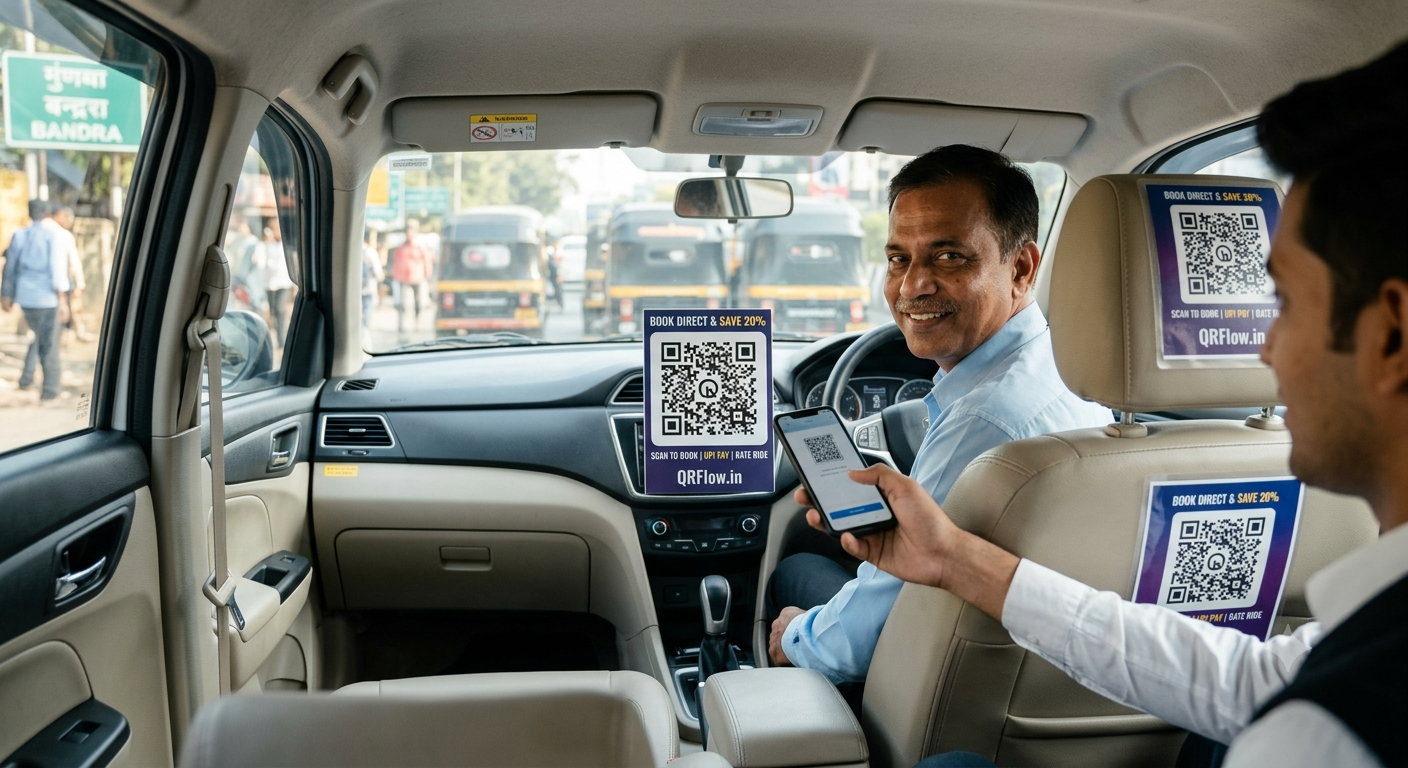
For independent taxi drivers, fleet owners, and tourist cab operators across metro hubs like Mumbai, Bengaluru, and Delhi-NCR, traditional physical marketing (visiting cards, seatback pamphlets, cab wraps) has a high failure rate. Standard printed media is static: phone numbers change, vehicle permits get updated, or promotional fare tables become obsolete.
When a passenger leaves a taxi with a traditional paper card, that touchpoint usually gets lost. If a driver changes their contact details or shifts from individual operations to a city fleet service, printed cards turn into dead links—costing future repeat bookings and customer lifetime value.
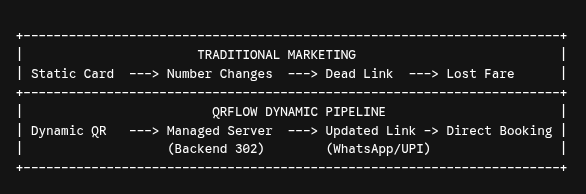
Using dynamic QR codes bridges the offline-to-online (O2O) gap. If a driver changes their phone number, updates their tariff card, or switches their fleet registration, the dynamic target URL updates instantly in the background without needing to reprint physical collateral.
Static vs. QRFlow Dynamic QR Codes: Operational Comparison
Static QR codes hardcode destination URLs directly into the pattern matrix. Dynamic QR codes utilize a lightweight managed short URL that routes visitors through an enterprise redirection layer.
| Feature / Metric | Static Free QR Codes | QRFlow Dynamic Enterprise |
|---|---|---|
| Redirection Control | Permanent (Hardcoded target URL) | Flexible 301/302 Redirection |
| Data Tracking & Analytics | None | Full Scan Attribution (City, Device, OS, Time) |
| Payment Flow Support | Basic UPI string (Static amount/VPA) | Dynamic UPI & WhatsApp integration |
| Link Integrity & Safety | Vulnerable to malicious domain changes | Secure Managed Layer & Custom Subdomains |
| Customization & Branding | Basic black-and-white patterns | High-res vector exports with custom logos |
| DPDP Act Compliance | Uncontrolled data collection | Anonymized data collection protocols |
5 Field-Tested Use Cases for Independent Indian Taxi Drivers
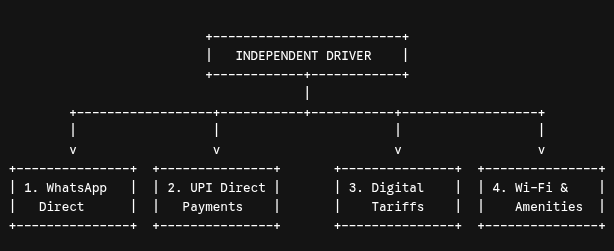
1. The Instant WhatsApp Direct Booking Engine
Rather than asking passengers to manually save a 10-digit mobile number to book future outstation journeys, place a QRFlow dynamic code on the dashboard or passenger headrests. Scanning opens a pre-filled WhatsApp conversation (e.g., "Hi, I'd like to book a trip for...").
- Drivers capture lead contacts immediately.
- Reduces friction for repeat rides to tech parks, airports, or railway stations.
2. High-Speed UPI Payment Collection & Zero-Touch Fare Settlement
Static UPI codes can degrade over time when exposed to sunlight on dashboards, causing scan failures during payment. Dynamic QR routing ensures high redundancy and error correction:
- Displays clean payment gateways supporting PhonePe, Google Pay, Paytm, and BHIM.
- Prevents misdirected payments by verifying Virtual Payment Addresses (VPAs) through secure gateway redirects.
3. Digital Rate Cards & Outstation Tour Packages
Urban traffic regulations and seasonal fuel price adjustments require flexible fare displays.
- Link the QR code to a dynamic PDF or mobile micro-page showing outstation fare charts (e.g., Mumbai to Pune, Bengaluru to Mysuru).
- Update peak-season pricing or driver allowance policies remotely via the dash without reprinting seatback flyers.
4. Passenger Wi-Fi & Onboard Entertainment Access
Delight business travelers and long-distance riders by offering frictionless Wi-Fi onboarding.
- A single scan securely connects passenger devices to the vehicle hotspot.
- Redirects users to an onboarding landing page highlighting custom outstation packages or daily rental subscriptions.
5. Instant Review & Reputation Aggregation
Build local trust across Google Maps and local transport directories.
- Display a seatback QR code with a clear call to action: "Scanned your trip? Rate your ride!"
- Direct satisfied customers straight to your Google Business Profile review link to increase local search visibility.
Technical Superiority: Managed Redirection, Latency, & Security
Switching from platform dependency to business independence requires software infrastructure that guarantees high uptime and security.
1. Ultra-Low Latency Optimization
In mobility use cases, scans often occur on moving vehicles with fluctuating 4G and 5G connections. QRFlow utilizes localized edge-server routing to process 302 redirects in under 50 milliseconds. This prevents drop-offs caused by slow loading times.

2. Managed Redirections & Brand Security
Free dynamic QR generators often use unverified domain shorteners that get flagged by web browsers or security software. QRFlow protects your link integrity:
- Employs SSL/TLS encryption for all redirection pathways.
- Prevents domain hijacking and broken destinations through centralized link monitoring.
3. Precision Scan Attribution Analytics
Understand passenger demographics and peak booking windows without violating user privacy:
- Geographic Distribution: Identify where scans occur (e.g., Airport drop-off zones vs. IT corridors).
- Device & OS Breakdown: Target high-yield services (like premium outstation rentals) based on iOS vs. Android usage trends.
- Temporal Patterns: Track scan counts by time of day to optimize driver availability.
4. DPDP Act 2023 Compliance
India’s Digital Personal Data Protection (DPDP) Act imposes clear guidelines on data handling. QRFlow processes analytics using anonymized telemetry methods:
- Zero tracking of personally identifiable information (PII) during the redirection step.
- Fully compliant scan attribution for Indian business operations.
3-Step Implementation Guide for Drivers & Fleet Operators
Getting your independent taxi business equipped with dynamic QR codes requires just a few minutes.

- Account Setup & Access: Sign Up for QRFlow to create your primary management account, or Login to your Dashboard if you already have an active profile.
- Design & Dynamic Target Configuration: Select your target destination—such as a direct WhatsApp API link (https://wa.me/91XXXXXXXXXX) or dynamic rate card URL. Apply custom branding, upload your logo, and export your QR code in scalable vector formats (SVG/EPS) for high-quality printing.
- Deploy & Track Analytics: Review the QRFlow Features module to monitor scan performance. Adjust target destinations anytime without changing your physical printed QR codes. For team or fleet-level account upgrades, review our competitive plans on QRFlow Pricing or reach out via our Contact Page.
Frequently Asked Questions (FAQ)
1. Why should independent taxi drivers use dynamic QR codes instead of regular static codes?
Static QR codes cannot be edited once printed. If your contact number, fare chart, or payment VPAs change, printed marketing materials become useless. Dynamic QR codes allow you to modify the backend target destination instantly while keeping the printed physical code intact.
2. Is QRFlow fully compliant with Indian data protection laws?
Yes. QRFlow operates in alignment with the Digital Personal Data Protection (DPDP) Act 2023. Scan attribution analytics gather aggregate, non-personal operational data (OS, device type, general location) without harvesting PII.
3. How does WhatsApp integration work through a dynamic QR code?
The dynamic QR code stores a short link that redirects the passenger's mobile browser directly into the WhatsApp app. It opens a chat window addressed to your business number, complete with a pre-formatted introductory message.
4. Will my QR code stop working if scan volume increases during peak travel seasons?
No. Enterprise dynamic infrastructure is scaled to handle fluctuating traffic without rate-limiting scans. You can review available limits and account parameters anytime on our Pricing Page.
5. Can I use a single QR code for both payments and ride bookings?
Yes. You can link your dynamic QR code to a custom mobile landing page hosted through QRFlow. This page can present clear options for passengers: Pay via UPI, Book Next Ride via WhatsApp, or View Outstation Tariffs.