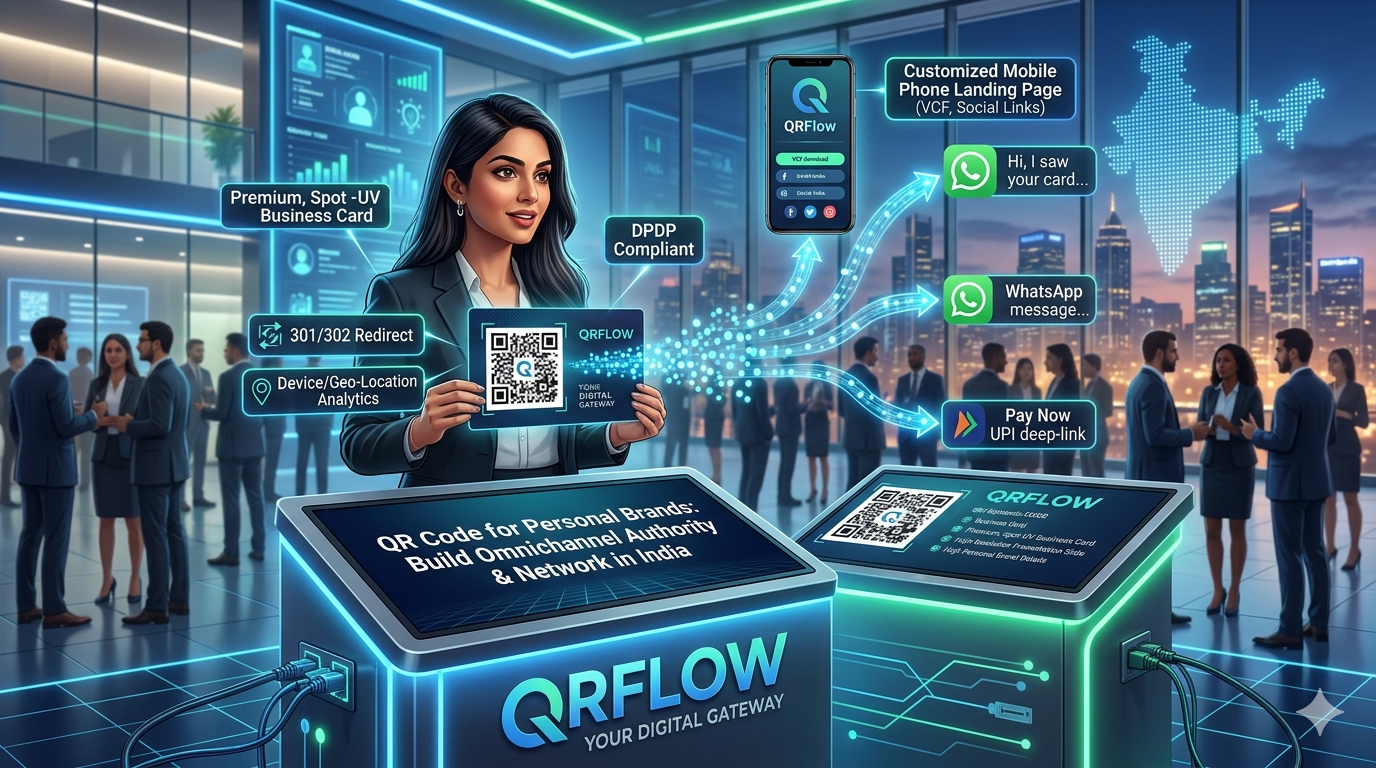
For founders, content creators, and independent professionals in India, physical interactions—ranging from local tech meetups in Bengaluru to global summits at the Jio World Convention Centre—are critical customer acquisition channels. You exchange business cards, hand out book samplers, or display your social handles on presentation slides.
However, relying on printed URLs or static QR codes introduces a massive vulnerability: the dead link risk.
If you change your primary website domain, update your Instagram handle, or migrate your portfolio from one platform to another, every single piece of printed material instantly becomes obsolete. The financial loss isn't just the printing cost of those premium 400 GSM spot-UV business cards; it’s the permanent loss of high-intent professional connections, potential consulting clients, and media opportunities.
In the competitive Indian digital economy, physical-to-digital (Phygital) friction kills momentum. If a prospective investor or client scans your code and hits a 404 error, your brand authority drops immediately.
Technical Comparison: Static vs. QRFlow Dynamic Architecture
Understanding the underlying infrastructure of QR technology is crucial before deploying your personal brand assets.
- Static QR Codes: Encode your destination URL directly into the matrix data pattern. The longer the URL, the denser and more complex the pixel pattern becomes, reducing readability in low-light environments. Once printed, the destination cannot be altered.
- QRFlow Dynamic QR Codes: Encode a short, optimized placeholder URL. When a user scans the code, our system executes an instantaneous, low-latency redirection to your designated destination. This structure allows you to modify the destination URL at any moment without ever altering the printed QR code design.
| Capability / Feature | Static QR Codes | QRFlow Dynamic Framework |
|---|---|---|
| Post-Print URL Modification | Impossible (Requires Re-printing) | Unlimited Instant Updates via 301/302 Redirects |
| Data Density & Scan Speed | High Density (Complex pattern, slow scan) | Minimalist Matrix (Ultra-fast low-light decoding) |
| Scan Attribution & Analytics | Zero Data Captured | Comprehensive (Device, OS, State-Level IP Geo-location) |
| Lead Generation Capabilities | Direct Routing Only | Middle-tier Intercepts (e.g., One-Click WhatsApp Opt-in) |
| Data Protection Compliance | Unregulated / High Risk | Built-in DPDP Act 2023 India Compliance |
| Custom Brand Domain Masking | Not Supported | Supported via Custom White-Label Slugs |
6 Deep-Dive Use Cases for Indian Personal Brands
Optimizing your Offline-to-Online (O2O) attribution strategy requires deploying dynamic QR codes across distinct brand touchpoints. Here is how top Indian professionals utilize QRFlow to capture high-value leads:
1. The Interactive Corporate Business Card
Traditional business cards end up in desk drawers or trash bins. By embedding a QRFlow dynamic code on your physical card, you turn it into an active gateway. Route users directly to a customized, mobile-optimized landing page featuring your VCF contact download file, recent press features, and your calendar booking link. If you switch your scheduling tool from Calendly to a local alternative, update the link instantly in your dashboard without reprinting your cards.
2. High-Conversion Speaker & Presenter Slides
When presenting at major industry events like NASSCOM or dynamic local tech meetups, your closing slide is your highest-leverage asset. Instead of displaying a complex URL or a laundry list of social handles, use a single high-resolution dynamic QR code styled with your personal brand palette. Route the audience to a dedicated landing page where they can download your presentation PDF in exchange for their email address or LinkedIn follow, capturing hundreds of inbound B2B leads simultaneously.
3. Book Authors & Independent Newsletter Publishers
If you are self-publishing a book on Amazon India or running a Substack newsletter (such as a deep-dive on the Indian fintech ecosystem), place a dynamic QR code on the back cover or at the end of Chapter 1. Offer a bonus chapter, a downloadable toolkit, or access to an exclusive community channel. If your community platform shifts from Slack to Discord, update the destination link instantly behind the scenes.
4. Direct-to-WhatsApp Consulting Lead Capture
In India, friction-free communication happens on WhatsApp. You can configure your QRFlow asset to initiate a pre-filled chat conversation. When an enterprise client scans your code at an exhibition booth, their WhatsApp app opens automatically with a message like: "Hi, I scanned your code at the Delhi Tech Expo. I'd like to schedule a strategic consulting audit." This bypasses friction-heavy email forms entirely, boosting response rates.
5. Seamless UPI Payment & Professional Tip Jars
For independent artists, performers, coaches, and creators hosting live physical workshops or webinars, collecting immediate, secure payments is vital. By leveraging India’s unified payment ecosystem, you can map a dynamic QR code directly to your UPI deep-link string (upi://pay?pa=yourvpa@bank...). This allows physical attendees to scan and open their preferred local banking app (GPay, PhonePe, Paytm) to clear invoices or register for premium cohorts instantly.
6. Video Creator O2O Cross-Promotion
If you produce high-quality video content on YouTube or hold audio spaces on X, use physical merchandise, stands, or retail pop-ups to drive subscriber growth. Place a dynamic code on your product packaging or studio backdrop. Configure the backend asset to direct traffic to your latest viral video upload or live stream link. As your content pipeline evolves daily, update the redirect destination to ensure your physical assets always promote your freshest, most relevant work.
Technical Superiority: Enterprise Infrastructure for Individual Creators
While basic, free online generators exist, they pose severe operational liabilities for professional personal brands. Free tools frequently leverage unmanaged, unoptimized redirects that hurt user experience, compromise privacy, or inject unauthorized third-party advertisements over time.
Advanced Scan Attribution & Deep Data Analytics
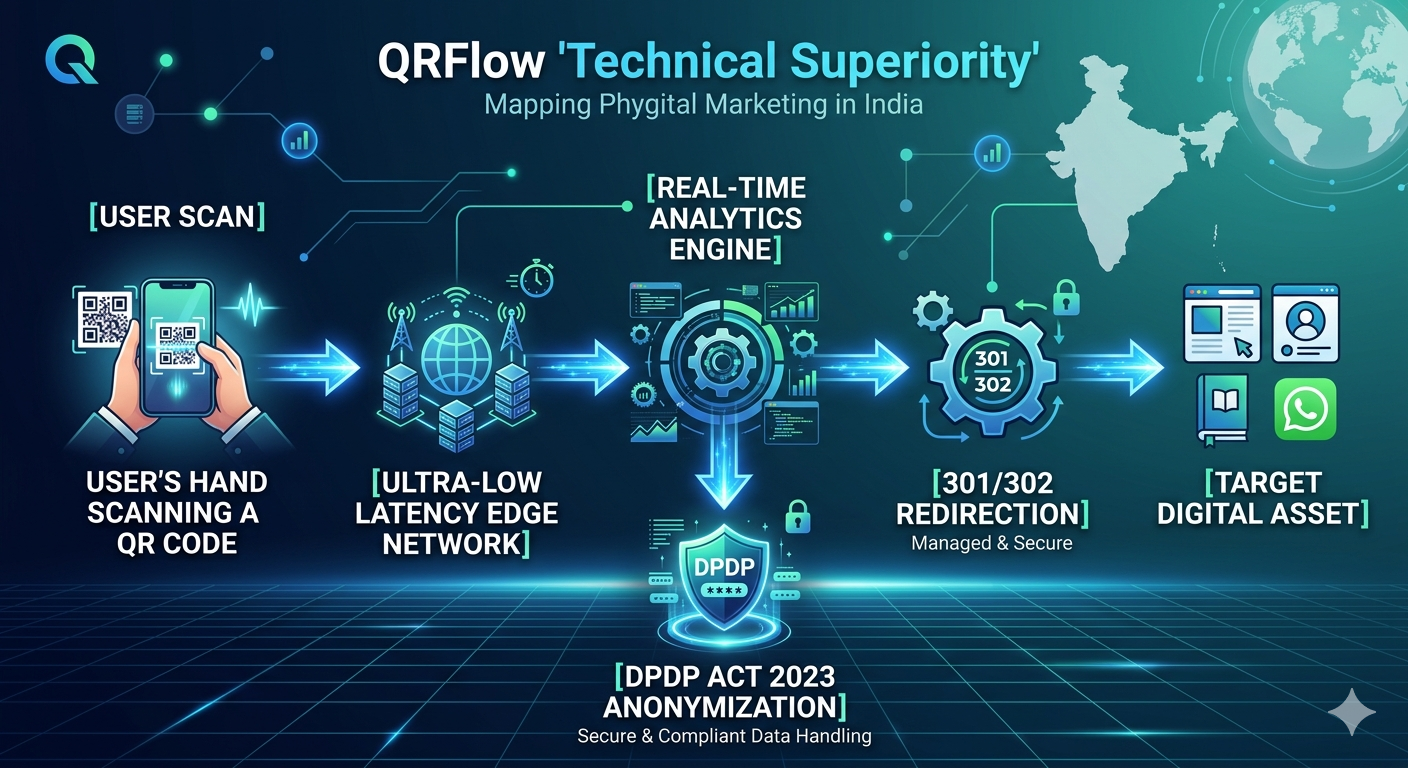
QRFlow delivers detailed, real-time telemetry on every scan event without compromising user trust. Within your premium dashboard, you can track performance metrics essential for evaluating your offline marketing ROI:
- Device & Operating System Distribution: Identify whether your audience leans heavily toward iOS or Android platforms, allowing you to optimize your digital portfolios for the dominant ecosystem.
- IP-Based Location Mapping: Pinpoint the specific metropolitan regions (e.g., Mumbai MMR, NCR, Bengaluru) generating the highest offline engagement, helping you plan future physical workshops or targeted regional digital campaigns.
- Hourly & Daily Scan Density: Analyze the exact times your audience interacts with your physical brand touchpoints to optimize live engagement windows.
Latency Optimization & Edge Infrastructure
In India's diverse network landscape—where users frequently alternate between high-speed 5G networks and congested 3G/4G spaces in transit hubs—every millisecond matters. A delayed redirect leads to high bounce rates. QRFlow utilizes an optimized global server architecture to process 301 and 302 managed redirects instantly. By keeping data packets lean and optimizing our redirection scripts, we ensure your page loads fast even under poor network conditions.
Brand Safety & Managed 301/302 Architecture
Free QR tools often use unpredictable multi-hop routing that can trigger browser security warnings or show competitor ads. QRFlow guarantees absolute link ownership. Our infrastructure deploys clean, direct HTTP status codes (301 for permanent migrations, 302 for temporary campaigns) to ensure search engine spiders accurately transfer link equity and authority to your primary web assets, maintaining your personal brand’s digital health and technical integrity.
Strict Compliance with the DPDP Act 2023
With India enforcing strict guidelines under the Digital Personal Data Protection (DPDP) Act 2023, individual personal brands operating as data fiduciaries face compliance obligations. Collecting raw, personally identifiable information (PII) without explicit consent during a routine QR scan carries significant legal risk. QRFlow’s architecture prioritizes privacy by default. We process IP and location data through an anonymization layer, providing high-value market insights while fully protecting consumer data privacy.
Strategic Implementation Guide: Launching Your O2O Brand Pipeline
Building an active, high-converting physical-to-digital bridge for your personal brand takes just a few clicks.
Step 1: Create Your Account
Visit the QRFlow Sign Up Page to set up your professional dashboard. If you already have an active profile, simply navigate to the QRFlow Login Gateway to access your administrative suite.
Step 2: Design and Configure in Your Dashboard
Select the "Dynamic QR" option to ensure your physical assets remain evergreen. Paste your primary digital destination URL (such as your Linktree, personal website, or custom WhatsApp link). Customize the design matrix to match your brand aesthetics:
- Incorporate your custom brand colors.
- Embed your personal brand logo or headshot into the center of the code pattern.
- Ensure high contrast between the foreground blocks and background spaces to maintain optimal scan capability across different printing surfaces.
Step 3: Download, Print, and Monitor Performance
Export your custom asset in scalable vector formats (SVG or EPS) to ensure crisp, clean printing on everything from standard business cards to massive out-of-home (OOH) conference banners. Once deployed, monitor your traffic trends through the dashboard. Review the QRFlow Advanced Features Suite to explore more deep-linking strategies and check the QRFlow Flexible INR Pricing Structure to scale your account as your audience expands.
India Business FAQ: Dynamic QR Codes for Personal Branding
Q1: Is there a limit to how many times a dynamic QR code can be scanned on QRFlow?
No. Unlike free online utilities that cap your monthly traffic or cut off your links after a set number of clicks, QRFlow provides high scan allowances tailored to handle sudden viral traffic spikes across all our professional tiers. Your links stay active when you need them most.
Q2: Do QRFlow dynamic codes comply with India’s DPDP Act 2023 guidelines?
Yes, absolutely. Our analytics platform is engineered around privacy-first principles. We track macro-level telemetry data—such as geographic states, device operating systems, and scan times—without collecting or storing PII like un-hashed IP addresses or tracking cookies, keeping your personal brand compliant with Indian data regulations.
Q3: Can I link a single QR code directly to my UPI handle for professional payments?
Yes. You can input your standard UPI string directly into our dynamic engine. When an attendee scans the code, it triggers an absolute deep-link command on their mobile device, instantly launching their installed payment applications (like PhonePe, GPay, or Paytm) to complete a secure transaction.
Q4: Can I change the destination URL after the QR code has been printed on physical cards?
Yes, that is the primary benefit of our dynamic system. You can update your target destination URL inside your dashboard at any time. The physical code matrix remains identical, instantly redirecting new scanners to your updated digital assets without requiring any reprints.
Q5: Can I use my own custom domain for the QR link rather than a generic address?
Yes, premium members can set up custom domain masking. This feature allows you to use your own branded URL structure for redirects, ensuring your audience sees your name and personal brand at every step of the scanning process.
If you have custom enterprise deployment requests or technical questions, reach out directly through our QRFlow Official Support Channel.