
For premium inter-city travel agencies, car rental operators, and corporate fleet managers operating across Indian hubs like Mumbai, Delhi-NCR, and Bengaluru, vehicle wraps are high-visibility real estate. Every month, a single car logs thousands of impressions on national highways and city choke points.
Historically, companies pasted static QR codes or printed phone numbers directly onto these vehicle wraps to capture customer bookings, driver evaluations, or emergency inquiries. However, this approach exposes a critical operational vulnerability: the dead link.

If your booking URL changes, if a specific regional branch office closes, or if a dedicated phone number is decommissioned, those physical prints instantly transform into broken links. To fix a single link mistake across a distributed fleet of 50 or more cars, you must:
- Recall every vehicle to a physical depot.
- Peel off the existing vinyl.
- Reprint and re-apply new wraps.
This process incurs massive vehicle downtime and costs upwards of ₹10,000 per car in material and labor. Meanwhile, thousands of prospective passengers scan broken codes, leading to dropped acquisition funnels and severe brand erosion.
Operational Architecture: Static QR vs. QRFlow Dynamic Infrastructure
To scale fleet operations efficiently, agencies must separate the physical printed asset from the digital destination layer. QRFlow achieves this via managed 301/302 redirection architecture. The physical car wrap features a single, unchangeable QR code that points to a secure QRFlow short URL. From the central cloud dashboard, administrators can instantly modify the destination endpoint in real time without ever touching the vehicle.
| Capability Feature | Legacy Static QR Codes | QRFlow Dynamic Infrastructure |
|---|---|---|
| Destination Modification | Impossible. Hardcoded into the pixel pattern at generation. | Instant. Change destination URLs globally in less than 1 second. |
| O2O Attribution Tracking | Zero data. You only know total website traffic, not traffic origin. | Granular scan attribution (Device, OS, timestamp, city-level location). |
| Fallback Redirection | Breaks completely if the destination page returns a 404 error. | Advanced 302 routing to active landing pages, apps, or backup numbers. |
| WhatsApp Business Routing | Hardcoded to a single number; cannot handle shifts or rotations. | Dynamic query parameters (?text=...) and location-based routing. |
| Data Privacy (India) | Unregulated data capture risks violating domestic privacy laws. | Built-in compliance protocols aligned with the DPDP Act 2023. |
| Global Standards Compliance | None. Uses proprietary, unoptimized data packaging. | Pre-configured to support forward-compatible GS1 Digital Link standards. |
5 High-Authority Fleet Use Cases for the Indian Market
1. Geo-Targeted Booking Funnels and Localized WhatsApp Routing
A traveler waiting at a toll plaza on the Mumbai-Pune Expressway sees your luxury sedan and scans the rear window QR code. Instead of dropping them onto a generic homepage, QRFlow parses the request and executes a targeted redirect.
The code automatically launches a pre-filled WhatsApp Business chat mapped directly to the western region's booking desk:
https://wa.me/91XXXXXXXXXX?text=I%20am%20interested%20in%20booking%20a%20ride%20from%20Mumbai%20Expressway
If the same car is reassigned to Delhi-NCR next quarter, a 5-second dashboard update updates the target phone number and localized pre-filled text. This guarantees zero friction, moving prospects from an offline impression to a live sales conversation instantly.
2. Multi-Lingual Driver Safety & Feedback Mechanics
Passenger safety and compliance with regional transport regulations are critical. A single vehicle frequently crosses state borders—moving from Karnataka to Maharashtra, for example.
By utilizing dynamic language-negotiation redirects, a single QR code on the passenger seatback detects the user's smartphone system language. It then serves a clean, localized driver feedback form in Kannada, Marathi, Hindi, or English, dramatically increasing compliance and response rates.
3. Immediate In-Transit UPI Payment Gateway Adjustments
For corporate car rental services, handling ad-hoc billing extensions or toll re-imbursements during transit requires seamless execution. Fleet managers can transform vehicle QR codes into dynamic payment collection terminals.
If your agency changes its corporate banking relationship or switches payment aggregators (e.g., from Razorpay to Cashfree), you do not need to distribute new physical payment placards to your 50+ drivers. Simply update the underlying UPI deep-link schema inside your central dashboard to route funds directly to the new merchant account.
4. Fragmented Out-of-Home (OOH) Phygital Marketing Validation
When running high-investment wrapped campaigns across multiple metropolitan areas, validating return on ad spend (ROAS) is historically difficult. QRFlow provides native scan attribution.
By assigning unique tracking IDs to different batches of vehicles (e.g., 10 cars in Bengaluru, 20 cars in Delhi, 20 cars in Mumbai), marketing teams gain exact metrics on which geographic fleet generates the highest offline engagement. This transforms passive transit assets into trackable elements of your phygital marketing mix.
5. Instant SOS and Breakdown Protocol Routing
When an unexpected vehicle breakdown or accident occurs on a remote highway, drivers can panic, and passengers need fast assistance. A dedicated "SOS & Support" QR code placed on the dashboard allows anyone to scan and instantly pull up real-time fleet emergency hotlines, current GPS coordinates, and immediate road-assistance chat channels.
If the primary support desk experiences an outage, system admins can switch the backend routing to an alternative call-center provider instantly, maintaining unbroken operational resilience.
Technical Superiority: Why Free Tools Compromise Fleet Operations
Using open-source or free QR code generators for commercial enterprise fleets introduces critical operational, legal, and performance risks.
Sub-50ms Latency Optimization
Every redirect introduces a time delay. Free tools often funnel traffic through oversubscribed, low-tier proxy servers located outside India, causing latency spikes of 2 to 4 seconds. In areas with spotty 4G/5G highway connectivity, this delay causes the browser connection to time out, losing the customer entirely.
QRFlow utilizes a highly optimized backend infrastructure with local edge servers inside India. This minimizes redirect latency to sub-50ms intervals, ensuring near-instantaneous page loads even on remote transport corridors.
Comprehensive Analytics Architecture
Understanding customer behavior requires deep, multi-dimensional telemetry data. Free alternatives do not capture or process detailed scan contexts. QRFlow records and visualizes key data points in real time:
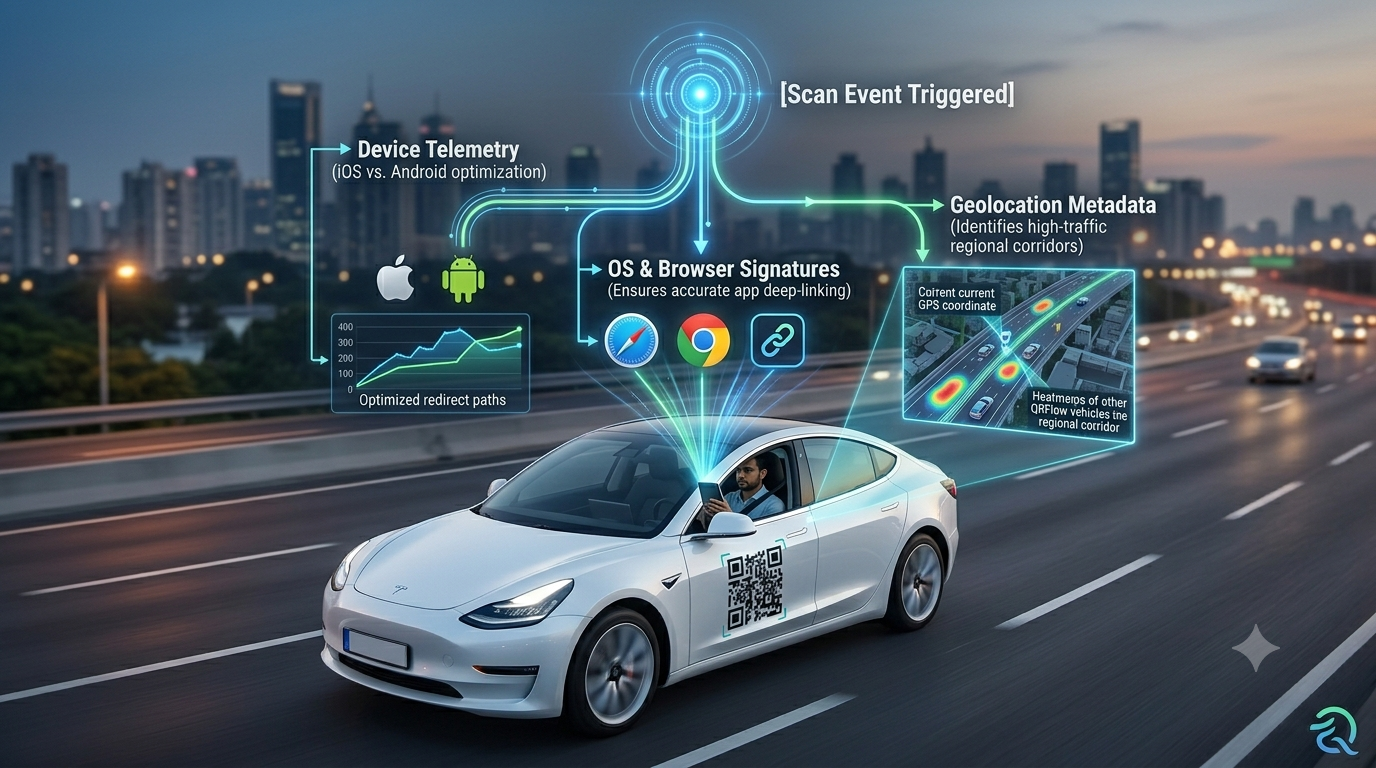
This telemetry helps fleet managers realize if 70% of their highway scans originate from iOS users in Haryana, allowing them to adjust their target digital ad targeting accordingly.
Brand Protection and Managed Redirection Security
Free dynamic QR providers completely control your routing domain. If their domain is flagged for spam, goes down, or gets blocked by Indian Internet Service Providers (ISPs), your printed fleet codes immediately break.
QRFlow mitigates this by utilizing enterprise-grade domain masking and secure 301/302 redirects. Your fleet's QR codes run on fully protected, high-reputation network nodes, ensuring your physical assets are safe from domain blacklisting or malicious traffic hijacking.
Indian Regulatory and DPDP Act 2023 Compliance
Under the Digital Personal Data Protection (DPDP) Act 2023, tracking an individual's precise personal data without explicit consent carries severe penalties. Free tracking tools often harvest raw IP addresses and sensitive user metrics indiscriminately.
QRFlow anonymizes processing data at the network edge, ensuring your agency collects aggregated, high-utility business analytics without storing personally identifiable information (PII). This protects your business from compliance audits and legal exposure.
Deployment Guide: Centralizing 50+ Vehicles in 3 Steps
Transforming a distributed fleet into a structured digital asset network is straightforward. Follow this implementation plan:
Step 1: Initialize Infrastructure and Bulk Architecture
Navigate to the QRFlow Sign Up Page to establish your corporate workspace. Instead of generating codes one by one, map out your fleet structure using a standardized nomenclature (e.g., DL-01-UB-1024-Tier1). Use the bulk creation features inside the dashboard to generate your initial batch of 50+ unique dynamic redirect placeholders simultaneously.
Step 2: Configure Dynamic Routing and Vector Design
Access the QRFlow Login Page to open your visual management console. Apply your corporate branding, high-contrast colors, and logo integrations via the dashboard styling suite. Ensure you download the final assets in high-resolution, infinitely scalable vector formats (.SVG or .PDF). This prevents pixelation and distortion when the graphics are scaled up for large commercial SUV or bus wraps.
[Dashboard Design Console] ──► Inject Logo + High Contrast Styling ──► Export Ultra-High Res SVG
Step 3: Launch Live Scan Attribution and Tracking
Deploy the generated vector files directly to your vinyl printing vendor. Once the vehicles hit the road, monitor live interactions by reviewing the diagnostic telemetry suite on the main QRFlow Features Page. From here, your team can adjust marketing campaign landing pages, rewrite automated WhatsApp text strings, or update support numbers on the fly based on incoming data.
India Fleet Operations FAQ
1. Can we change the destination URL after the vinyl wrap is applied to 50+ cars?
Yes, absolutely. That is the core advantage of using a dynamic platform. The physical pattern printed on the vinyl wrap routes through a permanent shortened URL link. You can alter the final destination address inside your admin account at any time, and the updates go live instantly across all 50+ vehicles without requiring any reprinting.
2. How does the system handle poor 4G or 5G connectivity on Indian national highways?
QRFlow uses a lightweight data payload alongside extreme backend latency optimization. Because our routing architecture processes transactions at edge servers located inside India, the redirect executes much faster than standard websites. This allows pages to load successfully even in low-bandwidth, remote highway environments.
3. Are there any restrictions on the total number of scans our fleet can receive?
Unlike basic free packages that cut off traffic or redirect to ads after hitting low thresholds, our enterprise plans feature high-capacity volume limits tailored for large-scale operations. For clear tier pricing breakdowns mapped in Indian Rupees (INR), please review the QRFlow Pricing Page.
4. Is the data tracked via vehicle scans compliant with the Indian DPDP Act 2023?
Yes. QRFlow is built with strict privacy-first constraints. Our analytics suite tracks device categories, operating systems, and generalized regional locations without storing raw IP addresses or tracing personal tracking tokens. This approach gives you high-utility business insights while remaining fully compliant with current Indian data protection laws.
5. We operate across multiple distinct travel sub-brands. Can we manage them from one place?
Yes. The platform includes multi-tenant folder grouping and advanced workspace isolation tools. This allows your administrative staff to oversee separate fleets, different regional branches, or distinct sub-brands from a single integrated dashboard. If you need a customized corporate deployment or custom API integrations, you can reach out directly via our QRFlow Contact Page.