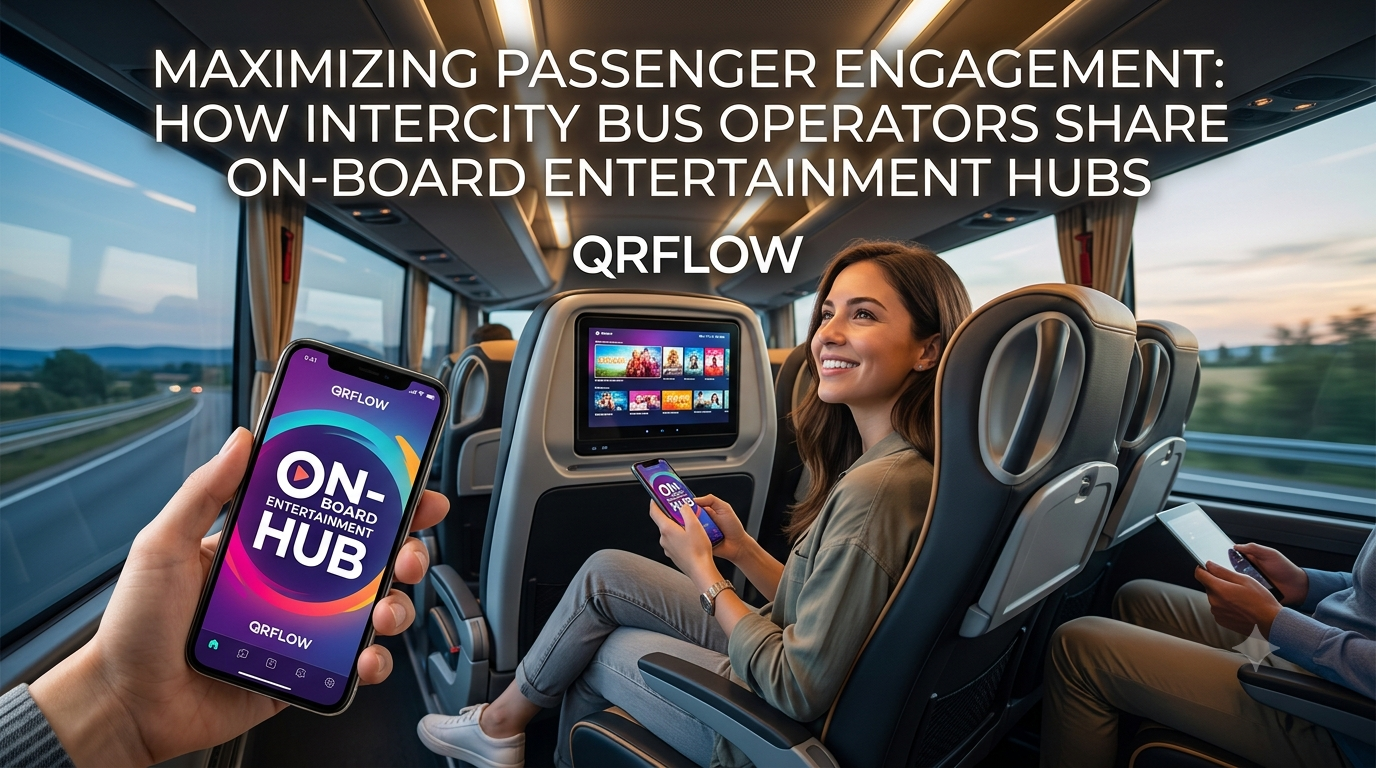
Every day, hundreds of luxury sleeper and multi-axle AC buses roll out from major hubs like Majnu ka Tilla in Delhi, Anand Rao Circle in Bengaluru, or Kalasipalyam to ferry millions of long-distance passengers across India. To enhance the passenger experience, operators invest heavily in printing visual materials—seatback stickers, headrest covers, and physical tickets—featuring QR codes that point to mobile apps, Wi-Fi login pages, or local streaming portals.
But what happens when an internal streaming server IP changes mid-route? What happens when a marketing campaign expires, or a local transit partnership shifts?
With traditional static QR codes, that physical print instantly becomes a "Dead Link."
For an operator managing a fleet of 50+ buses, the financial and operational drag of a dead link is severe:
- The High Cost of Re-Printing: Replacing seatback stickers across an entire fleet requires thousands of rupees in print design, materials, and specialized workshop labor.
- Vehicle Downtime: Buses must be pulled out of active service routes into depots just to swap out expired print media, destroying optimization targets.
- Broken Passenger Trust: A passenger scanning a broken link on an 8-hour overnight route between Mumbai and Goa experiences immediate frustration, driving down retention scores.
In the highly competitive Indian phygital marketing space—where offline physical assets directly trigger online digital interactions—relying on unmanaged links is a systemic vulnerability. This is where modern O2O Attribution (Offline-to-Online) infrastructure changes the game.
Architectural Comparison: Static QR Codes vs. QRFlow Dynamic Engines
To understand why free or basic generators fail modern enterprise transit demands, we must examine the underlying mechanics of link redirection. Static QR codes encode destination URLs directly into the pixel pattern; if the URL changes, the code is permanently broken.
QRFlow utilizes highly optimized 301/302 Redirection architectures. The code points to a permanent, ultra-fast cloud server gateway that fetches and forwards the user to the active target instantly.
| Feature / Metric | Standard Static QR Codes | QRFlow Dynamic Infrastructure |
|---|---|---|
| URL Flexibility | Hardcoded; permanent and unchangeable once printed. | Completely flexible; update destination URL instantly via cloud dashboard. |
| Link Redirection Protocol | None (Direct routing). | Enterprise-grade 301/302 Redirection engine. |
| Scan Attribution & Analytics | Zero tracking capability. | Real-time analytics tracking device type, operating system, and IP-location. |
| Content Personalization | Static, single-destination page. | Conditional routing based on daytime, location, or operator schedules. |
| Data Privacy Compliance | Unregulated, high security risk. | Built specifically around DPDP Act 2023 frameworks. |
| Branding Control | Generic URLs that invite domain spoofing. | Custom short domains for optimal brand security and white-label trust. |
6 Deep-Dive Use Cases for Indian Intercity Fleet Operators
Transforming a bus cabin into an interactive digital environment requires strategic touchpoints. Here are six high-impact scenarios tailored specifically for the Indian transit ecosystem using the core Features of the platform.
1. The Seatback Entertainment Grid (Zero-Buffering Intranet Hubs)
Instead of installing expensive, high-maintenance seatback hardware screens that age quickly, operators print a single, robust dynamic QR code on the rear tray table of every seat. When scanned, the passenger is instantly routed to the bus's local media streaming server. If the server architecture migrates from local hardware to a cloud-based content delivery network (CDN), the fleet manager updates the backend target URL in seconds, preserving the physical sticker across thousands of vehicles.
2. Frictionless UPI Food & Beverage Pre-Ordering
Long-distance routes across national highways often feature designated food stops. By placing dynamic QR codes near armrests, operators allow passengers to view live menus and complete orders mid-journey. Integrating seamless UPI payment flows means passengers authorize transactions instantly inside apps like GPay, PhonePe, or Paytm. The orders are aggregated by the crew and prepared before the bus even arrives at the highway dhaba, shortening transit delays.
3. Real-Time WhatsApp Business Customer Support Channels
When traveling over long distances, passengers frequently have immediate questions regarding ETA, restroom stops, or air conditioning adjustments. By configuring a dynamic QR code that maps directly to a deep-linked WhatsApp Business integration, passengers don't need to manually type or save support numbers. A simple scan pre-populates a custom chat string containing the bus route details, letting central operations resolve queries smoothly without causing on-board disruptions.
4. Captive Portal Wi-Fi Onboarding With Zero Latency
Providing free on-board Wi-Fi is a fantastic value proposition, but getting passengers to navigate complex login screens manually is a major hurdle. A dedicated dynamic onboarding QR code takes passengers directly to the verification page. By leveraging server-side Latency Optimization, the system ensures the redirect occurs smoothly even when the bus passes through areas with spotty 4G or 5G highway coverage.
5. Instant Passenger Feedback Systems (The GSRTC Blueprint)
Following public sector benchmarks set by major transit networks like the Gujarat State Road Transport Corporation (GSRTC), modern operators deploy dynamic codes to capture passenger feedback regarding cabin cleanliness, driving safety, and staff behavior. Because these forms can be updated or localized depending on whether the route is an inter-state run or a regional service, dynamic routing guarantees that data lands in front of the correct regional depot manager instantly.
6. Dynamic Localized Affiliate Ads & Pitstop Partnerships
Turn your physical fleet into a high-yielding ad platform. You can display dynamic QR codes that change their destination based on the bus's destination. For instance, a bus traveling from Pune to Hyderabad can show ads for top-rated hotels, local taxi services, or regional food brands located specifically in Hyderabad as the bus nears its destination, unlocking completely new affiliate revenue streams.
The Technical Advantage: Behind QRFlow’s Low-Latency Enterprise Infrastructure
When thousands of passengers are traveling simultaneously across varying cellular networks, basic open-source QR scripts crash under load. Brand security and operational continuity demand an enterprise architecture built for scale.
Advanced Scan Attribution & Analytics
QRFlow delivers detailed tracking without violating consumer privacy. Every time a code is scanned on a highway route, our servers capture essential client parameters:
- Device Profiling: Detects whether the user is on an Android or iOS device to serve appropriately formatted mobile apps or streaming interfaces.
- Operating System & Browser Tracking: Identifies exact software profiles to assist in troubleshooting media playback bugs across older mobile phones.
- IP-Based Location Mapping: Real-time analysis maps the nearest telecom tower routing the request, providing operators with spatial insights into exactly where along the highway passengers engage most with content.
Managed Redirects for Absolute Brand Security
Using unmanaged public shorteners poses a severe corporate risk. If a public shortener goes down or gets flagged for spam, your printed assets point to dangerous security warnings. Our platform enforces isolated custom domains for all dynamic redirects. This isolates your corporate brand from generic web traffic, improves scanning speeds, and ensures your infrastructure strictly adheres to international GS1 Standards for data structure and readability.
Strict Compliance with India's DPDP Act 2023
Data governance is non-negotiable. The Digital Personal Data Protection (DPDP) Act 2023 mandates that citizen data must be handled with clear consent and minimal exposure. Our backend is engineered to process redirects completely without harvesting or permanently storing sensitive Personally Identifiable Information (PII) at the point of scan. Location tracking is calculated safely via aggregated IP ranges, ensuring your fleet remains completely compliant with Indian law.
Step-by-Step Implementation Guide to Launch Your Fleet Entertainment Grid
Setting up an enterprise-grade digital transport network takes only a matter of minutes. Follow this streamlined workflow to get started.
1.Register and Configure Your Transport Workspace:Takes under 3 minutes.
Navigate to the Sign Up Portal and establish your fleet operations account. If you are an existing enterprise partner, log in directly via the Login Portal. Define your short tracking domains within your central dashboard to ensure all generated codes carry your official transport brand name.
2.Design and Generate Dynamic Vector Layouts:Custom brand integration.
Access your design space to craft high-resolution vector codes that remain readable even under variable lighting conditions inside passenger cabins. Integrate your transport logo, customize brand color configurations, and match your bus's interior design guidelines. Set your initial target links to point to your localized streaming servers or digital assets.
3.Deploy Across Fleet and Monitor via Analytics Panel:Real-time control.
Print your generated high-density graphics onto durable vinyl or seatback media stickers. Once deployed across your active vehicles, manage, iterate, or fully switch target URLs directly from your cloud console without altering a single printed item. Review the analytics feed to monitor passenger engagement across all active travel routes.
FAQ: Strategic Answers for Fleet Operators
Q1: Is there a hard limit on the number of passenger scans supported per month?
No. Unlike free online alternatives that throttle or completely block traffic once a code gains traction, our business infrastructure is explicitly built to support enterprise-scale volumes. You can review our high-capacity limits tailored specifically for nationwide transport systems by exploring our transparent Pricing Plan Options.
Q2: How does the system handle rapid URL redirection when buses are on remote highways with weak 3G/4G connectivity?
Our infrastructure utilizes global edge servers optimized specifically for minimal round-trip latency. The data payload inside our dynamic redirects is stripped of heavy scripts, allowing the phone's browser to resolve the 301/302 Redirection almost instantaneously, even in low-signal highway corridors.
Q3: Can we use our own custom website domain for the generated QR codes instead of a generic link?
Yes, absolutely. For enterprise brand security and to build trust with passengers, we highly recommend mapping your own custom domain (e.g., media.yourtravelbrand.in) to our platform. This ensures passengers know they are scanning an official, safe corporate channel.
Q4: Are there hidden fees for changing destination links after the bus media is printed?
None at all. The core value of a managed dynamic platform is the freedom to change destination paths as often as your business requires. You can update links daily, set up automated scheduling, or change destinations based on real-time fleet operations without incurring extra charges.
Q5: How do we get support if a link requires structural integration with our custom ticketing API?
We offer specialized integration assistance for fleet enterprise architectures. For custom configurations involving deep linking into your native Android/iOS mobile apps or specialized on-board hardware, you can connect directly with our engineering team via the Official Contact Channel.