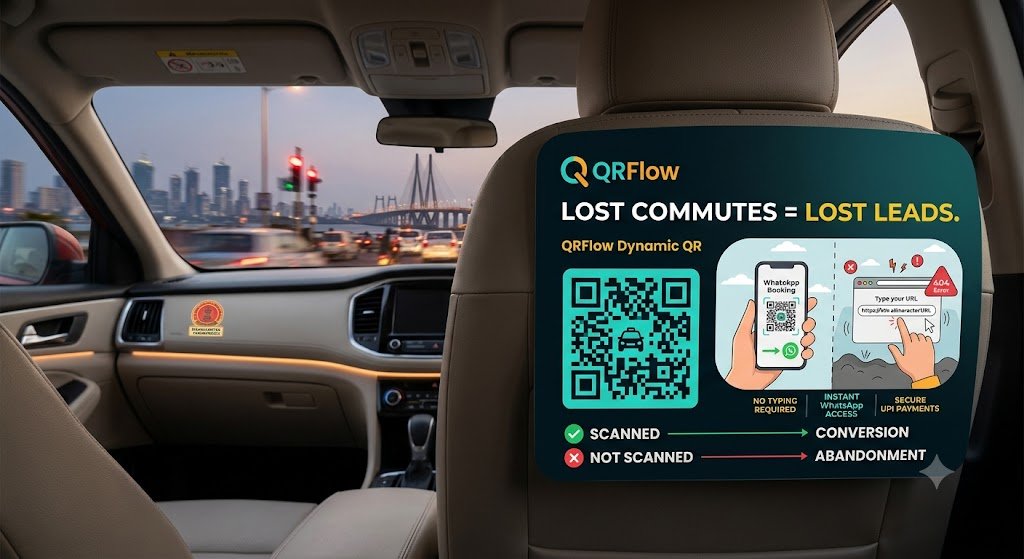
Every day, millions of commuters spend between 20 to 90 minutes inside cabs, auto-rickshaws, and intercity buses across Indian metros like Mumbai, Bengaluru, Delhi-NCR, and Hyderabad. For fleet aggregators, ride-hailing partners, and premium taxi services, this captive attention represents prime Phygital Marketing real estate.
However, traditional in-cab marketing relies on printed headrest covers, seatback stickers, or physical pamphlets featuring static web links or lengthy sign-up forms.
Why Traditional Forms Fail inside Moving Cabs
- Friction Kills Conversion: Expecting a passenger navigating bumpy roads or city traffic to manually type a URL into a mobile browser leads to immediate abandonment.
- The "Dead Link" Traps: When a promotional campaign ends, printed decals become obsolete immediately. Replacing physical seatback covers across thousands of vehicles costs significant time and money in printing and field ops.
- Zero O2O Attribution: Traditional print offer no way to track which specific vehicle, driver, route, or city generated a lead. Fleet managers are left completely blind regarding Offline-to-Online (O2O) return on investment.
When physical collateral links to expired URLs or broken landing pages, it damages brand trust and wastes valuable ad space. Moving from static collateral to dynamic link management allows operators to update destinations remotely without reprinting a single sticker.
Static vs. Dynamic In-Cab QR Codes: An Operational Comparison
| Feature Capability | Static QR Codes | QRFlow Dynamic Infrastructure |
|---|---|---|
| Destination URL Flexibility | Permanently fixed at print time; requires reprinting to change. | Real-time destination updates via 301/302 managed redirects. |
| Scan Analytics & Attribution | Zero tracking capability; blind deployment. | Real-time scan attribution (device type, OS, IP location, time-of-day). |
| WhatsApp Integration | Manual user navigation required. | Direct 1-Tap WhatsApp Business API trigger for auto-fill leads. |
| Scan Redirection Speed | Dependent on destination server speed. | Latency optimization via global edge CDNs for instant loading. |
| Compliance & Data Privacy | Unverified third-party tools expose data. | Fully compliant with India's DPDP Act 2023 regulations. |
| Custom Branding & Vectors | Basic black-and-white grids with poor visual appeal. | Custom colors, embedded logos, and SVG/EPS vector downloads. |
6 High-Impact In-Cab QR Use Cases for Indian Fleet Operators
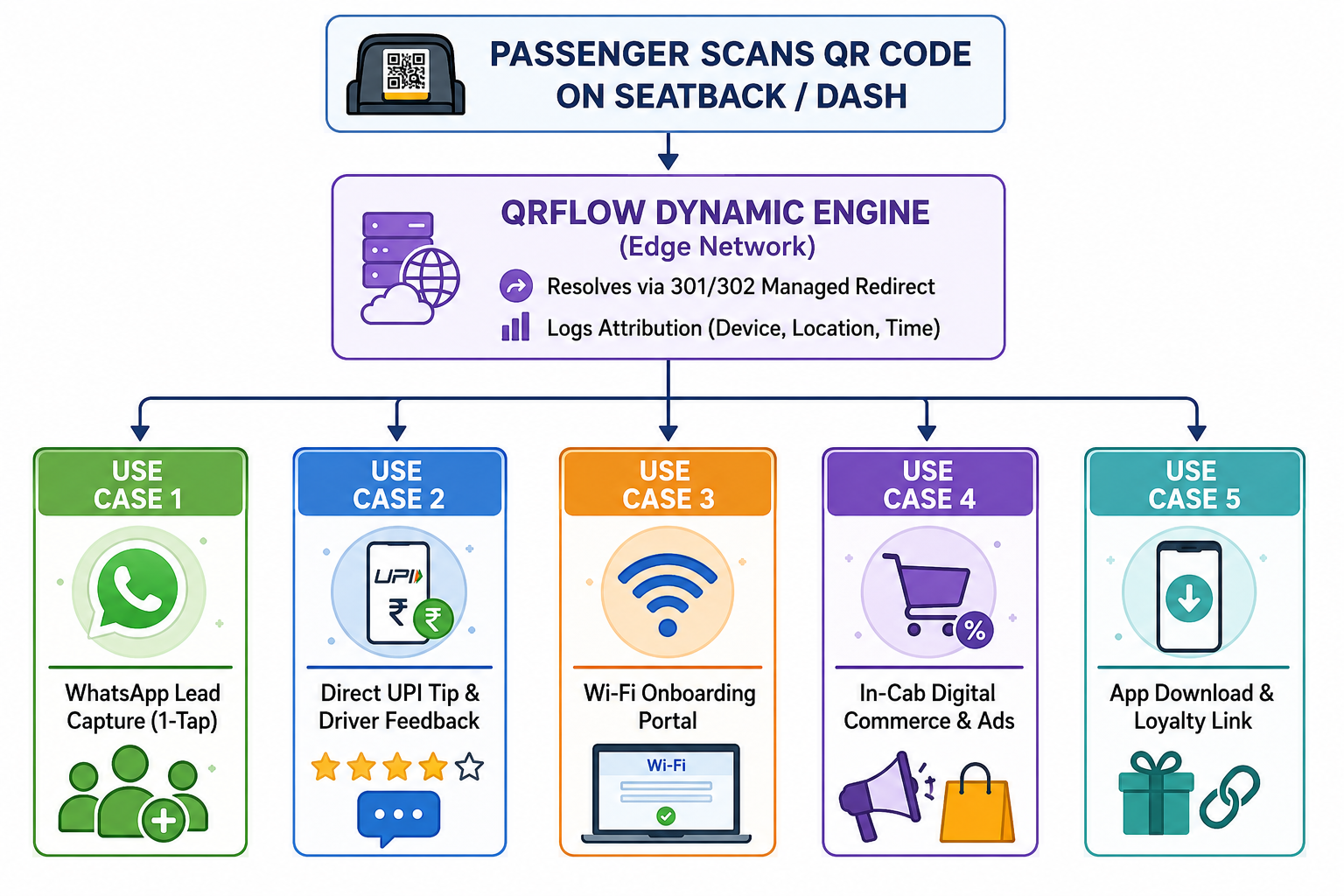
1. 1-Tap WhatsApp Lead Capture for Airport & Outstation Bookings
Instead of asking a passenger to fill out a 6-field web form on a moving vehicle's screen, embed a dynamic QR code linked to a pre-filled WhatsApp click-to-chat link. When scanned, the passenger's native WhatsApp opens with a pre-typed message:
"Hi, I am riding in Cab #KA01AB1234 and would like to book a return airport drop for Friday."
The passenger taps "Send," instantly providing the operator with a verified phone number and booking intent without typing a single character.
2. Instant Driver Tipping & Feedback via Dynamic UPI Integration
Driver retention and customer satisfaction rely on fast feedback loops. Place a customized QR code on the back of the front-seat headrests that routes passengers to an instant driver review portal with integrated UPI payment links (Google Pay, PhonePe, Paytm, BHIM). Passengers can rate their ride and tip the driver directly using their preferred UPI app in seconds.
3. Automated In-Cab Wi-Fi Onboarding
Offering complimentary Wi-Fi in premium luxury fleets or intercity coaches? Static password signs lead to passenger frustration and constant requests to the driver. Displaying a dynamic Wi-Fi QR code allows passengers to scan and auto-connect to the vehicle's hotspot credentials instantly—no manual password entry required.
4. Interactive In-Cab Commerce & Local Ad Monetization
Transform fleet cabins into digital storefronts. Display dynamic QR codes on passenger-facing windows or seatbacks that change based on the time of day or geolocation:
- Morning Commute (8 AM - 10 AM): Scans redirect to a breakfast ordering menu for destination pickup.
- Evening Commute (6 PM - 9 PM): Scans display localized food delivery discounts, movie ticketing offers, or local event promotions.
Because destination URLs update dynamically in the backend, ad inventory can be sold to local Indian businesses on a weekly or monthly rotation without touching physical vehicles.
5. Seamless App Downloads & First-Ride Coupons
For growing fleet startups aiming to migrate offline street-hail passengers to their mobile app, place custom QR codes inside the vehicle. The dynamic redirect engine detects whether the scanning phone runs Android (Play Store) or iOS (App Store) and automatically routes the user to the correct app store page with a pre-applied first-ride promo code.
6. Vehicle Verification & Driver Safety Badges
Enhance passenger safety and regulatory transparency by replacing paper transport permits with secure QR badges on dashboards or rear windows. When scanned by passengers or traffic authorities, the badge displays the driver's verified transport license, vehicle insurance status, and emergency SOS contacts maintained on a secure, centrally managed cloud server.
The Technical Advantage: Why Enterprise Fleets Rely on QRFlow
For large fleet networks managing hundreds or thousands of active vehicles, free web generators and unmanaged redirect engines pose severe business risks. Unreliable routing, slow scan resolution, and security vulnerabilities can hurt campaign outcomes and compromise user safety.
1. Edge-Engineered Latency Optimization
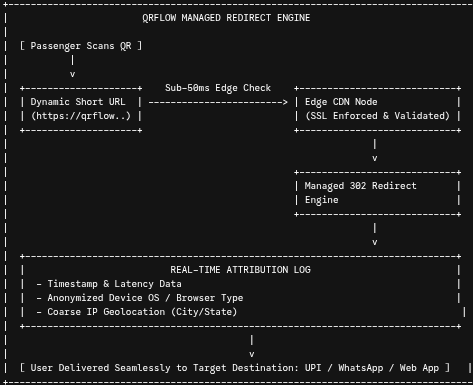
In moving vehicles, network conditions shift rapidly between 5G, 4G, and low-coverage zones. QRFlow processes dynamic redirects across edge infrastructure, ensuring sub-50ms server response times. The link resolves instantly before the passenger's mobile connection can drop out.
2. Managed 301/302 Redirect Architecture
Security is critical when deploying physical QR codes at scale. Free or low-cost QR providers are vulnerable to domain hijacking or sudden service shutdowns, which can render thousands of printed decals useless overnight. QRFlow provides managed 301 and 302 redirect loops with SSL encryption and domain isolation, protecting your brand's digital assets.
3. Advanced Scan Analytics & Geolocation Tracking
Without accurate data, fleet marketing is just guessing. QRFlow's analytics engine logs every interaction in real time:
- Device & Operating System Breakdown: Tailor destination experiences specifically for iOS vs. Android users.
- Time-of-Day Heatmaps: Discover when passengers are most engaged during their trips.
- Coarse Geolocation Data: Track which city fleets or specific regional depots generate the highest user engagement.
4. Fully Compliant with the Indian DPDP Act 2023
With the enforcement of India's Digital Personal Data Protection (DPDP) Act 2023, gathering user telemetry requires strict data privacy measures. QRFlow's analytics engine anonymizes consumer device markers at the edge, logging operational telemetry without collecting personally identifiable information (PII) without explicit consent.
5. Vector Output & GS1 Standard Compatibility
Fleet branding requires high-resolution printing on durable materials like vinyl wraps, acrylic boards, and metal plates. QRFlow allows design teams to export custom branded QR codes in vector formats (SVG, EPS, PDF) along with high-res PNGs. Codes can also be configured to meet GS1 digital link standards, ensuring full compatibility with global enterprise supply chains.
3-Step Implementation Guide for Fleet Managers
Deploying dynamic QR infrastructure across your transport fleet takes only a few minutes.
Step 1: Create Your Secure Business Account
Start by creating your account on the QRFlow Registration Page. If you already hold an account, access your central dashboard directly via the QRFlow Login Portal. Choose a subscription plan tailored to your fleet size on our transparent Pricing Page.
Step 2: Design & Custom-Brand Your Dynamic Assets
Navigate to the interactive creation wizard to customize your QR code assets:
- Add your brand's logo, select brand colors, and configure error-correction levels to maintain high readability even if the printed sticker gets scratched or worn over time.
- Set destination routing targets—such as a WhatsApp Business API URL, an in-cab menu landing page, or a dynamic UPI payment link.
- Download high-resolution SVG or EPS vector files for your printing vendor.
Step 3: Deploy, Track & Optimize Remotely
Affix the printed stickers across your fleet's seatbacks, dashboards, or windows. Log in to the dashboard to monitor live scan volumes, evaluate campaign ROI, and update landing destinations across your entire vehicle network instantly from a single interface. Explore all advanced tracking controls on the QRFlow Features Page.
Frequently Asked Questions (FAQ) for Indian Fleet Operators
1. Are QRFlow dynamic QR codes fully compliant with India's DPDP Act 2023?
Yes. QRFlow's redirect architecture is designed to respect consumer privacy. Edge analytics log coarse telemetry (such as device type, browser platform, and approximate city location via IP lookup) without extracting personally identifiable information (PII) or saving sensitive mobile data without consent.
2. What happens if a printed QR code inside a cab gets partially scratched or dirty?
QRFlow generates dynamic codes with configurable Error Correction Levels (up to Level H - 30%). This built-in redundancy ensures that even if up to 30% of the printed QR code area is damaged, scratched, or obscured by dirt, the scanning engine can still reconstruct the data and redirect the passenger smoothly.
3. Can we change the destination URL after printing and installing 5,000 seatback decals?
Yes. That is the core advantage of dynamic QR infrastructure. You can change the target destination URL inside your QRFlow dashboard anytime. The update takes effect immediately across all physical locations—no reprinting or physical vehicle maintenance required.
4. Do dynamic QR codes expire if our monthly scan volume spikes during major campaigns?
No. QRFlow's cloud architecture is built to scale smoothly during high-traffic events, festival seasons, or viral ad campaigns without breaking redirects. You can review scan limits and upgrade tier allocations on our Pricing Page.
5. How does QRFlow handle direct WhatsApp Business and UPI payment integrations?
QRFlow supports deep-linking protocols. When configuring your dynamic QR code, you can input deep-link URI schemes (such as whatsapp:// or upi://pay). When scanned by a mobile device, the browser automatically opens the user's installed WhatsApp or UPI app (such as PhonePe, Google Pay, or Paytm) with pre-populated values for a smooth experience.