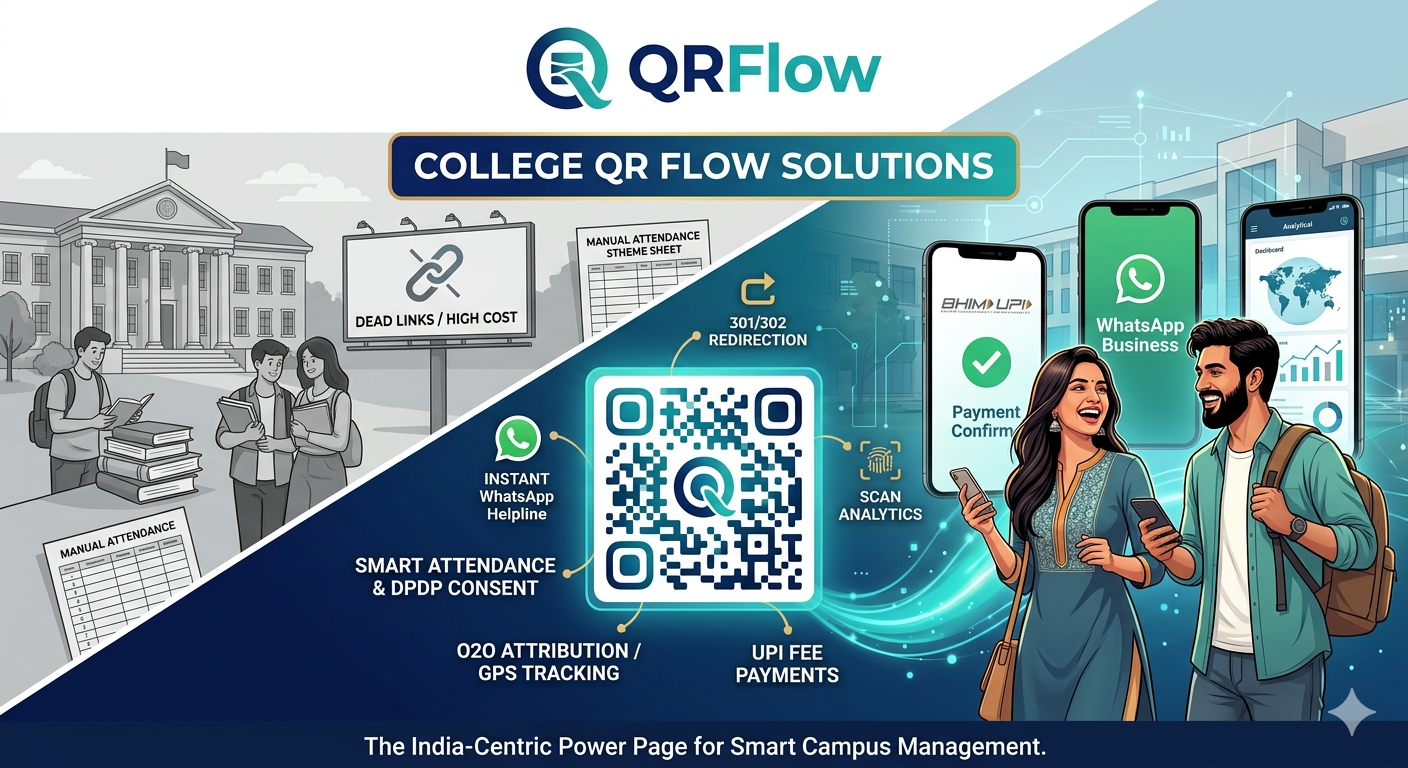
Every admission season, Indian colleges invest lakhs in high-impact physical marketing campaigns. Billboards on major highways, full-page advertisements in national newspapers, glossy prospectus booklets, and banners strewn across campus carry one critical flaw: permanence.
When an institution prints a standard static QR code pointing to an admission form, that link is set in stone. If the IT department updates the college website structure, shifts from an external admission portal to an in-house ERP, or if the application deadline passes, that printed QR code becomes a dead link.
For a prospective student, a broken link signifies technical incompetence and erodes institutional trust instantly. For the college, it represents wasted marketing spend, broken O2O (Offline-to-Online) attribution, and lost enrollment opportunities.
Furthermore, static QR codes offer zero visibility. Administrative boards are left in the dark, unable to measure which newspaper ad or billboard drove the highest student acquisition. In an era where data-driven decisions govern institutional budgets, relying on unmanaged, untrackable links is a multi-lakh liability.
Infrastructure Comparison: Static vs. QRFlow Dynamic QR Codes
To understand why leading Indian universities are transitioning their digital infrastructure, it is essential to look at the underlying routing technology.
| Feature / Capability | Standard Static QR Codes | QRFlow Dynamic Enterprise QR Codes |
|---|---|---|
| URL Flexibility | Hardcoded. Once printed, the destination URL cannot be changed. | Fully mutable. Uses 301/302 Redirection to update destinations instantly without changing the printed code. |
| Scan Attribution & Analytics | Zero tracking. No data on how many students scanned or where. | Granular tracking: Device type, Operating System (OS), and IP-based precise location data. |
| Brand Security & Phishing Risk | High. Vulnerable to tampering; cannot be paused or revoked if the destination is compromised. | Complete domain control, secure HTTPS routing, and real-time scanning fraud mitigation. |
| Data Customization | Limited. Higher data density makes the QR pattern complex and difficult for older smartphones to scan. | Optimized, low-density vector patterns optimized for instant, low-latency scanning on any budget device. |
| Indian Ecosystem Sync | None. Purely text or basic web redirection. | Native integration with UPI payment intents, WhatsApp Business, and Indian ERP systems. |
| Legal Compliance | No guardrails for user data tracking or privacy assurance. | Built to align strictly with the Digital Personal Data Protection (DPDP) Act 2023. |
7 Deep-Dive Use Cases for Higher Education in India
Integrating dynamic QR codes across a campus transforms a physical university into an interconnected, phygital ecosystem. Here are seven highly optimized deployment scenarios tailored for Indian higher education:
1. Unified UPI Fee & Fine Collection at Campus Counters
- The Scenario: Long queues at account offices for semester fees, exam form submissions, or library fines slow down administration.
- The QRFlow Solution: Generate dynamic QR codes embedded with UPI deep links directly at checkout counters, hostel mess entries, or administrative desks. Students scan using any preferred app (BHIM, GPay, PhonePe, or Paytm) to execute immediate peer-to-merchant transfers. This digitizes cash management, reduces reconciliation workloads for the finance team, and provides instant digital receipts.
2. Instant WhatsApp Business Admissions Helpline
- The Scenario: Prospective students and parents reading college brochures often have immediate questions regarding eligibility, hostel facilities, or placements.
- The QRFlow Solution: Place a dynamic QR code prominently on all physical prospectus materials, print ads, and standees. When scanned, it triggers a pre-filled WhatsApp message directed straight to the college’s official WhatsApp Business API account (e.g., "Hi, I want to know more about the B.Tech CSE admissions for 2026"). This initiates an automated chatbot flow, capturing the lead instantly and boosting conversion rates.
3. DPDP-Compliant Smart Attendance and Feedback Systems
- The Scenario: Manual attendance sheets are prone to proxy logging, while digital forms often collect user data without explicit consent structures.
- The QRFlow Solution: Professors project a dynamic QR code on the lecture hall screen at the start or end of class. The code uses secure time-expiry rules to prevent remote sharing. To fulfill the mandates of India’s DPDP Act 2023, the destination page includes clear, localized consent notices explaining exactly how student log data is stored and processed, ensuring comprehensive institutional compliance.
4. Interactive Phygital Campus Navigation & Virtual Tours
- The Scenario: Expansive university campuses can be highly confusing for new admissions, parents, and visiting recruitment companies.
- The QRFlow Solution: Mount weatherproof QRFlow codes on campus entry points, blocks, and labs. Scanning the code opens an interactive, mobile-optimized campus map or a 360-degree virtual tour of that specific department. This significantly improves the campus experience during orientation weeks and high-stakes placement drives.
5. Dynamic Placement Brochures & Recruiter Portals
- The Scenario: Printing massive placement brochures every year is expensive and quickly outdated as students accept offers or companies update profiles.
- The QRFlow Solution: Provide visiting HR executives with a sleek, printed placement booklet featuring a centralized dynamic QR code. The backend links to a live, cloud-hosted dashboard displaying real-time student CGPA data, verified resumes, and achievement portfolios. If a student gets placed mid-drive, their file can be modified or hidden instantly in the backend without reprinting costs.
6. Library Book Tracking & E-Resource Access via GS1 Standards
- The Scenario: Students browsing library shelves struggle to find corresponding e-books, journals, or video lectures related to a specific physical book section.
- The QRFlow Solution: Attach dual-purpose dynamic codes to library aisles or book jackets. QRFlow’s compatibility with GS1 Standards allows institutions to index physical assets while routing scanning students directly to supplementary digital research material, IEEE journals, or institutional repository downloads.
7. Secure Event Ticketing & Certificate Verification for Fests
- The Scenario: College cultural or technical fests face issues with fake ticket distribution and unauthorized entries.
- The QRFlow Solution: Issue unique dynamic QR codes for event entry tickets. Security personnel at the gates can scan tickets to verify authenticity in real-time. Post-event, the same ticket code can be dynamically redirected in the QRFlow dashboard to point to a secure download portal for the student's participation or merit certificates.
Technical Architecture: Why QRFlow Beats Free, Unmanaged Tools
Many institutions fall into the trap of using free, ad-supported online QR generators. While acceptable for casual use, these tools fail under enterprise workloads, compromise brand integrity, and present massive security loopholes.
Latency Optimization & Advanced Routing
When a student scans a QR code on campus, every millisecond counts—especially in areas with spotty cellular networks. Free tools often route traffic through slow, bloated third-party servers filled with intermediate ads.
QRFlow utilizes a high-velocity 301/302 Redirection engine built on an enterprise edge-network architecture. This guarantees microsecond-level Latency Optimization. When a user scans the code, they are routed to the intended destination almost instantly, drastically reducing drop-off rates.
Scan Attribution & Granular Analytics Dashboard
QRFlow changes physical media into a trackable asset class. Every single scan captures deep, non-PII (Personally Identifiable Information) analytical insights:
- Device & OS Tracking: Know whether your primary audience uses Android, iOS, or mobile browsers, allowing developers to optimize college portals accordingly.
- IP-Based Location Data: Track exactly which campus building, city, or state is driving the highest volume of traffic during multi-city admissions outreach.
- Time & Scan Density Analysis: Pinpoint peak interaction times to optimize when to push announcements or updates.
Brand Protection and Managed Redirection
Free QR code generators possess full control over the destination link. If their platform goes down, contains malware, or changes its business model, your printed campus codes can be redirected to malicious websites or broken pages.
With QRFlow’s managed redirect architecture, your links are protected by enterprise-grade firewalls. Your destination paths remain strictly under your control, ensuring that your institutional reputation is shielded against phishing, hijacking, or malicious domain changes.
Step-by-Step Implementation Guide for Campus Administrators
Deploying QRFlow across your university infrastructure takes less than five minutes and requires absolutely zero coding knowledge.
- Register & Set Up Your Workspace: Navigate to the QRFlow Sign Up Page to create an institutional account. Once registered, log into your central dashboard via the QRFlow Login Link.
- Design and Generate within Dashboard: Head over to the generator panel. Choose your destination asset type (URL, WhatsApp Intent, UPI String, or PDF). Customize the visual layout to match your college branding—incorporate your institutional logo, apply university colors, and select high-contrast eyes to guarantee effortless scanning across old and new smartphones alike. Explore advanced capabilities on our Features Directory.
- Deploy, Monitor, and Dynamically Update: Download your generated codes in high-resolution vector formats (SVG/EPS) ideal for large-scale print runs. Place them across your marketing assets, signage, or websites. Monitor real-time performance through the analytics dashboard. When a link needs to change next semester, simply edit the destination URL in your dashboard without touching the printed physical media.
Higher Education QR Deployment FAQ (Indian Context)
Q1: Is there a limit to the number of scans our campus QR codes can receive during peak admission months?
No. When you choose an enterprise tier from our INR Pricing Schedule, your dynamic QR codes come with unlimited scan capabilities. Whether you receive one hundred scans or one lakh scans during an intensive counseling week, your routing will remain completely uninterrupted and lightning-fast.
Q2: How does QRFlow help our university comply with India's DPDP Act 2023?
QRFlow tracks aggregate, operational data (such as OS, device types, and broad IP locations) without collecting explicit Personally Identifiable Information (PII) like names, phone numbers, or private emails directly through the scan routing layer. For forms or landing pages that do collect personal data, our platform allows you to configure seamless consent overlays, helping your legal team maintain absolute compliance with the Digital Personal Data Protection Act.
Q3: Can we generate official Tax/GST invoices for our institutional accounting department?
Absolutely. All plans available via our Pricing Structure are fully optimized for corporate and institutional procurement in India. During checkout, you can supply your university’s legal entity name and GSTIN to automatically generate valid tax invoices for internal compliance and audit verification.
Q4: What happens if a printed QR code gets partially scratched, torn, or damaged on a campus notice board?
QRFlow employs advanced Reed-Solomon error correction algorithms during generation. This mathematical fail-safe ensures that even if up to 30% of the physical QR code area is scratched, dirty, or torn by weather elements, the code remains fully readable by modern smartphone cameras.
Q5: Can we use our own custom university domain name for the tracking links instead of a QRFlow domain?
Yes, enterprise subscriptions allow you to configure custom white-label short URLs. This means instead of standard redirects, your students will see secure links matching your brand identity (e.g., qr.yourcollege.edu.in/admission), which builds massive trust and drastically increases scan engagement rates across campus.
If you have specific deployment questions regarding integration with your existing campus ERP or custom SIS platforms, please reach out directly via our Official Contact Channel to consult with an enterprise systems architect.