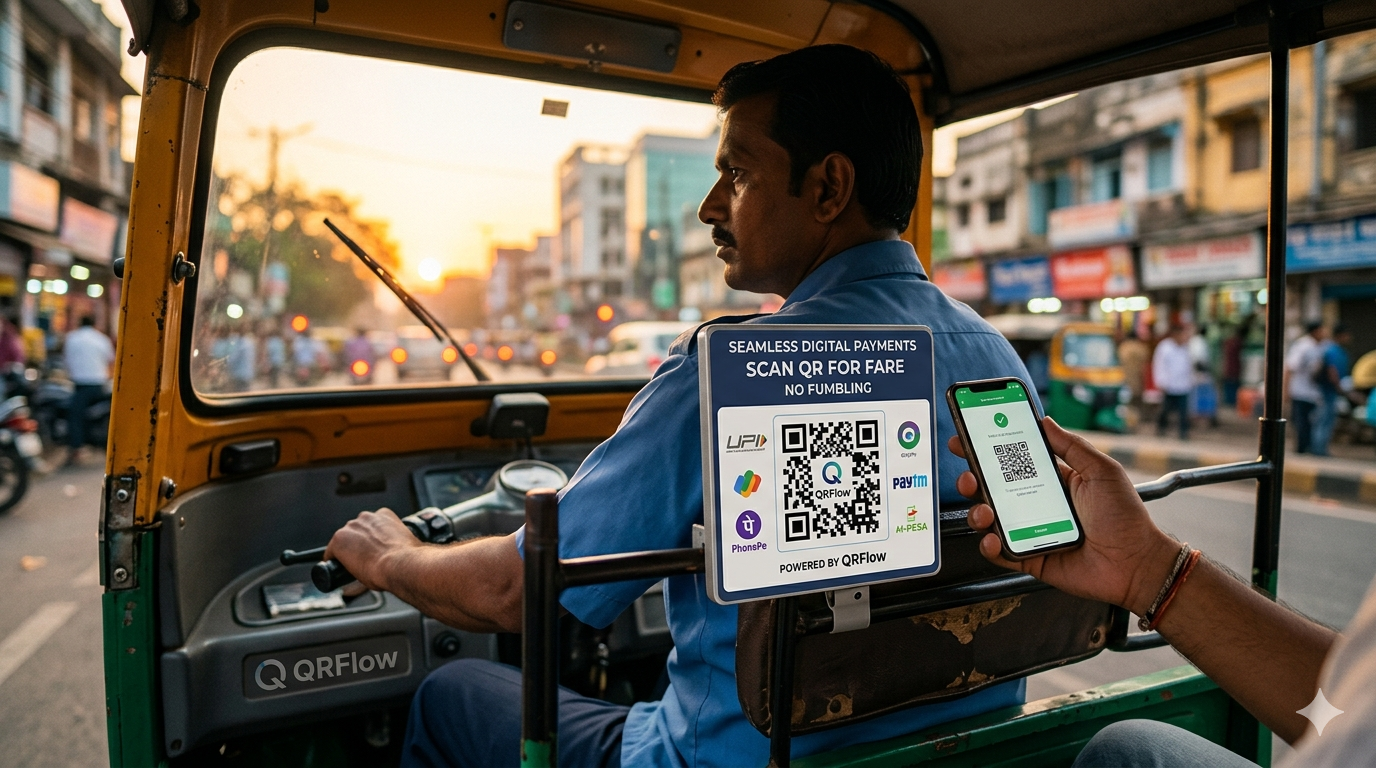
Every day across tier-1 hubs like Mumbai and Bengaluru, and rapidly expanding tier-2 markets, millions of commuters rely on auto-rickshaws for first- and last-mile transit. Yet, the physical payment touchpoint remains remarkably fragile.
Drivers frequently face transaction anxiety—fumbling with multiple laminate static prints on their dashboards, squinting at phones for SMS alerts, or losing fares due to network timeouts. For fleet aggregators and entrepreneurial operators managing thousands of three-wheelers, this operational blind spot is costly.
When a static UPI QR code fades under direct sunlight, scratches, or links to an unmonitored bank account, it creates a "Dead Link" in your physical revenue network. In phygital marketing and mobile transit operations—the intersection of physical assets and digital systems—a broken link means abandoned rides, corrupted transaction records, and total loss of O2O (Online-to-Offline) attribution.
To scale transit networks efficiently, operators must replace unmanaged static images with robust, dynamic routing systems built for the Indian digital ecosystem.
Technical Architecture: Static QR vs. QRFlow Dynamic Infrastructure
Unmanaged static QR codes store raw data directly within their data matrix. If a destination UPI identifier changes, or if a driver shifts to a different fleet vehicle, that physical asset becomes completely useless.
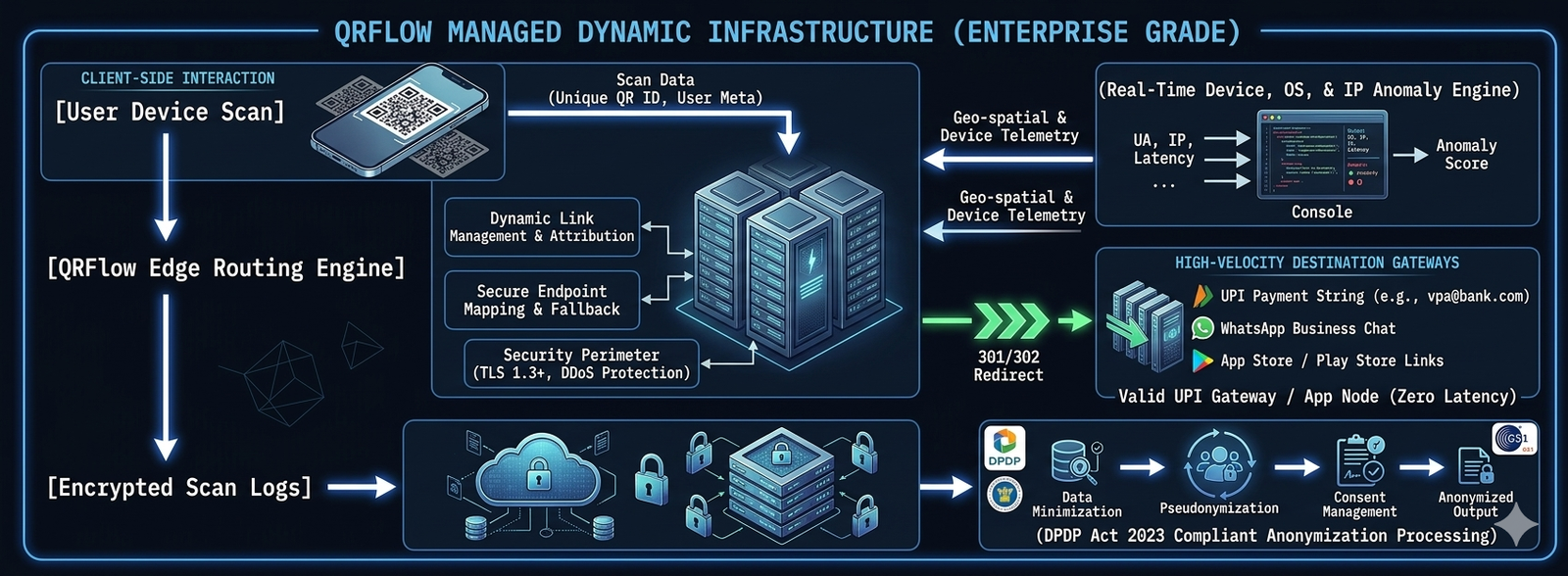
Conversely, QRFlow utilizes high-velocity server-side management. The physical matrix contains a permanent, highly optimized tracking URL that executes an instantaneous server-side redirection (via an optimized 301/302 Redirection engine). This keeps the printed physical code functional forever while allowing the underlying payment endpoints, vehicle IDs, and support channels to be updated instantly in the cloud.
| Architectural Dimension | Legacy Static QR Codes | QRFlow Dynamic Infrastructure |
|---|---|---|
| Data Binding Protocol | Hardcoded destination values. Permanent and unalterable after printing. | Decoupled via managed cloud routing endpoints. |
| O2O Attribution & Tracking | Zero telemetry. No visibility into scan volumes or consumer intent. | Real-time Scan Attribution tracking device parameters, timestamps, and locations. |
| Destinations & Multi-Routing | Single static text or payment string mapping. | Multi-destination routing: UPI payment string, WhatsApp support, or localized app download. |
| Link Integrity & Lifecycle | Susceptible to terminal failures ("Dead Links") if endpoints shift. | High-availability lifecycle management via centralized link infrastructure. |
| Latency Optimization | Dependent entirely on consumer mobile network DNS resolution. | Latency Optimization through distributed edge nodes ensuring sub-millisecond lookups. |
| Security Countermeasures | High vulnerability to physical QR tampering or malicious sticker overlays. | Automated destination verification with secure SSL/TLS handshakes and anomaly protection. |
5 Deep-Dive Enterprise Use Cases for the Indian Transit Ecosystem
Integrating dynamic routing grids into auto-rickshaw networks unlocks operational efficiencies that go far beyond basic point-to-point payment collection.
1. Dynamic UPI Routing with Automated Merchant Allocation
Instead of sticking five different bank QR codes onto a dashboard, a single asset built on QRFlow routes commuters through an optimized payment gateway array. If a primary banking partner experiences a network outage, the system dynamically reroutes traffic to a secondary bank node. This ensures transaction completion rates remain above 99% during peak transit hours.
Fleet operators can instantly re-map the underlying Virtual Payment Address (VPA) whenever a vehicle changes ownership or shift drivers, eliminating the need to re-print vehicle assets.
2. High-Speed WhatsApp Business Integration for Ride Receipts & Support
Commuters often need quick digital receipts for corporate expense tracking, or a fast way to report lost items. By scanning the dynamic code, passengers can be routed to open a verified WhatsApp Business chat sequence.
The system appends unique vehicle and driver identifiers directly to the message string. This creates a friction-free customer support loop that works seamlessly on low-bandwidth mobile connections across India.
3. Smart Localization via Device-Language Routing
India's commuter base is linguistically diverse. A passenger scanning a dynamic code in Chennai may prefer an interface in Tamil, while a user in New Delhi expects Hindi or English.
QRFlow detects the browser language parameters of the scanning device at the edge layer. It then instantaneously serving a highly localized digital invoice or onboarding screen, drastically reducing onboarding friction for regional commuters.
4. Direct App Onboarding via Dynamic Store Redirection
For transit aggregators looking to convert street-hail passengers into loyal app users, the dynamic matrix serves as a dual-action asset. It detects the device operating system via User-Agent strings.
Android devices are directed instantly to the Google Play Store, while iOS devices are routed to the Apple App Store. This eliminates search confusion and drives clean, trackable app installs directly from physical vehicle cabins.
5. Emergency SOS and Real-Time Driver Telemetry
Passenger safety is paramount in public transit. Fleet operators can embed a dedicated safety layer within the dynamic code structure.
When scanned during an active trip, the interface provides a prominent "SOS/Share Trip" trigger. This relays the vehicle’s specific telemetry and historical route data directly to emergency contacts or centralized command centers, building deep consumer trust through responsive phygital design.
Technical Superiority: Why QRFlow Beats Free Generators
Using free, ad-supported online QR generators exposes an enterprise transit network to significant security vulnerabilities, link decay, and operational risk.
Server-Side Telemetry & Precise Scan Attribution
Free tools merely encode strings; QRFlow builds an intelligent analytics pipeline around every physical asset. Our system captures highly granular telemetry without compromising end-user privacy:
- Device Profiles: Tracks distribution across hardware tiers (e.g., budget Android devices versus premium devices) to optimize mobile web application assets.
- Operating System Telemetry: Identifies OS versions to maintain broad compatibility with payment libraries.
- IP-Based Location Grids: Map transit scan densities across city sectors, helping fleet operators optimize vehicle allocation during peak hours.
Brand Integrity & Managed Redirections
When using generic generators, your data routes through untrusted domains that are vulnerable to hijacking, domain expiration, or malicious script injections.
QRFlow protects your brand identity by utilizing dedicated enterprise domains and pristine redirection architecture. This system ensures your commuters are never redirected through intermediate ad walls or compromised tracking scripts, preserving brand trust across millions of consumer impressions.
Extreme Latency Optimization & India-Scale Speed
In the fast-paced world of daily transit, a delay of even three seconds can cause a user to abandon a digital transaction and switch back to cash.
QRFlow’s core routing network is engineered specifically for high-velocity environments. Leveraging advanced caching strategies, our systems execute redirections at the edge, well ahead of the standard cellular tower lookup loop. This ensures instant performance even on crowded 3G or 4G networks during rush hour.
Compliance by Design: DPDP Act 2023 Compliance
Operating a consumer-facing digital footprint in India requires strict adherence to the Digital Personal Data Protection (DPDP) Act 2023. Free analytics tools frequently collect and monetize Personally Identifiable Information (PII) like raw IP addresses, precise GPS coordinates, and user profiles without explicit consent.
QRFlow anonymizes all incoming telemetry at the edge layer. We log macro-level hardware parameters and location regions without storing identifiable user data, insulating your transit firm from regulatory penalties and data compliance liabilities.
3-Step Fleet Implementation Guide
Deploying a managed dynamic routing asset across a fleet of thousands of vehicles takes just a few minutes using our enterprise dashboard.
Step 1: Initialize Your Enterprise Profile
Navigate to the QRFlow Registration Portal to establish your organizational dashboard. If you are an existing operator, quickly securely authenticate through the QRFlow Login Node. From here, select your account tier based on your expected monthly scan volume, referencing our localized QRFlow India Pricing Structure tailored for businesses managing growing regional operations.
Step 2: Configure Dynamic Targets & Physical Visuals
From the dashboard, choose Dynamic QR Configuration. Input your primary routing target—such as your unified transit landing page or dynamic UPI merchant string.
Next, access the design workspace to build a high-visibility, professional asset that reflects your brand identity. Be sure to export your design in crisp, high-resolution formats like SVG or PDF to prevent scanning errors caused by physical print pixelation.
Step 3: Deploy to Fleet Assets and Monitor Live Analytics
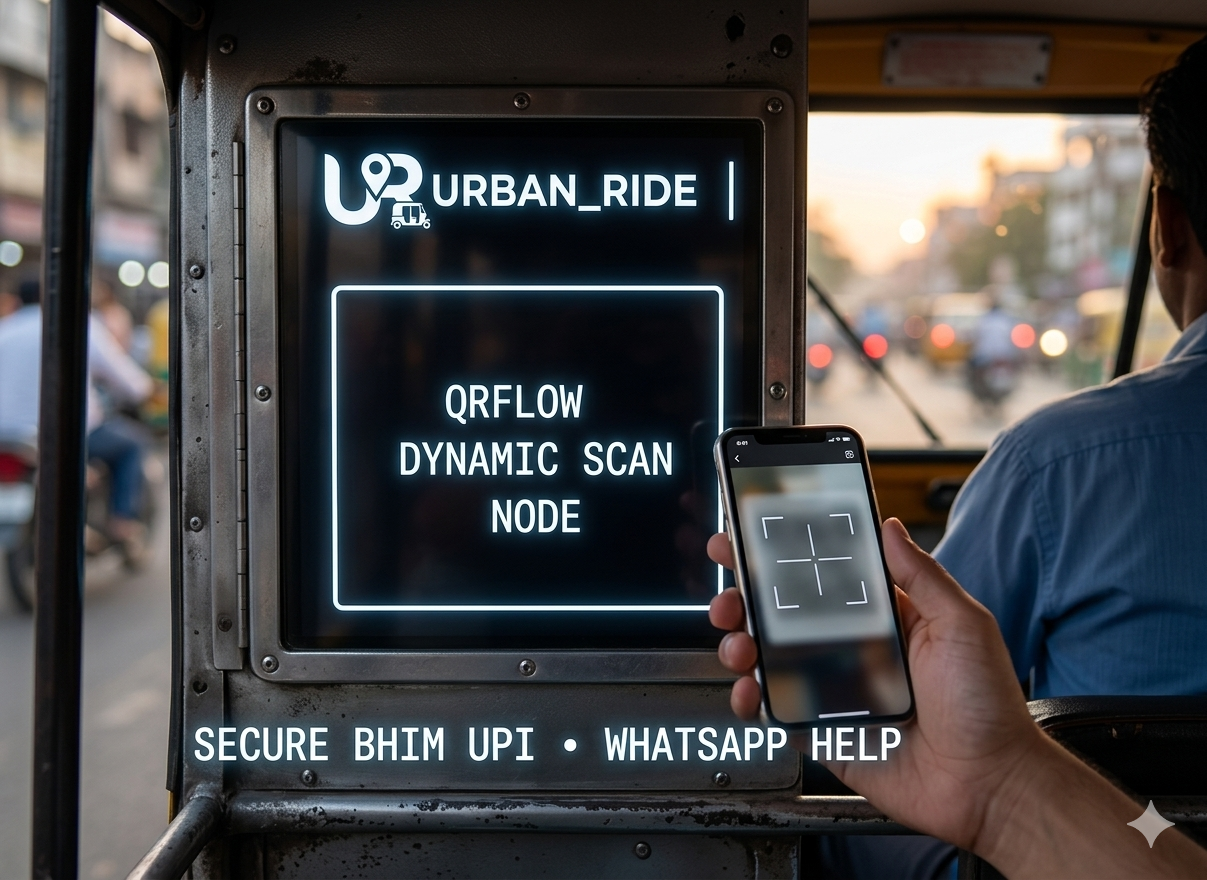
Print your optimized visual assets on durable, weatherproof materials like thick polycarbonate sheets or high-grade vinyl stickers to ensure they withstand harsh sunlight and daily wear. Fix them securely within the passenger cabin where they can be easily scanned.
Once deployed, review our complete QRFlow Core Features Engine to monitor live traffic performance, track operational uptime, and watch your transaction completion rates scale smoothly.
India Transit Operations: Frequently Asked Questions
1. Can we integrate dynamic QR assets with existing enterprise ERP frameworks?
Yes. QRFlow is built with developer-first API integration points. You can programmatically generate thousands of unique dynamic assets, update redirection endpoints based on vehicle re-assignments, and stream live scan telemetry directly into your internal logistics or fleet management software. For specific developer documentation, contact our architectural support team via the QRFlow Help Node.
2. Is there a hard cap on the total number of scans a dynamic code can handle during high volume?
Enterprise tier networks feature unlimited scan capacity. Whether a single asset inside a highly active auto-rickshaw is scanned twenty times a day, or a major campaign handles millions of rapid scans during peak transit hours, our distributed infrastructure handles the volume smoothly without throttling your traffic.
3. How does QRFlow help prevent physical QR fraud or sticker overlay attacks?
Physical tampering—where a bad actor sticks a fraudulent QR code over a driver's legitimate print—is a real risk for transit operators.
While operators should routinely check their physical vehicles, QRFlow helps mitigate this through smart anomaly detection. If our system detects rapid, unusual shifts in device patterns or sudden geofence anomalies across identical vehicle profiles, your dashboard flags it immediately so security teams can investigate.
4. Are these dynamic infrastructure flows fully compatible with GS1 India serialization standards?
Absolutely. QRFlow supports enterprise configurations that align with global GS1 Standards. This means you can easily embed standardized application identifiers (such as asset strings or global location numbers) right into your dynamic structures, keeping your fleet fully compatible with formal supply chain architectures.
5. What happens if a driver travels through an area with low 3G or 4G signal strength?
Because our dynamic code profiles are lightweight and data-minimized, they use incredibly small matrices. This makes them significantly easier for older smartphone cameras to read in low-light conditions.
Furthermore, our system cuts out bulky intermediate page scripts. Redirections happen near-instantaneously at our high-speed network edge, ensuring passengers can complete transactions smoothly even on weaker mobile connections.