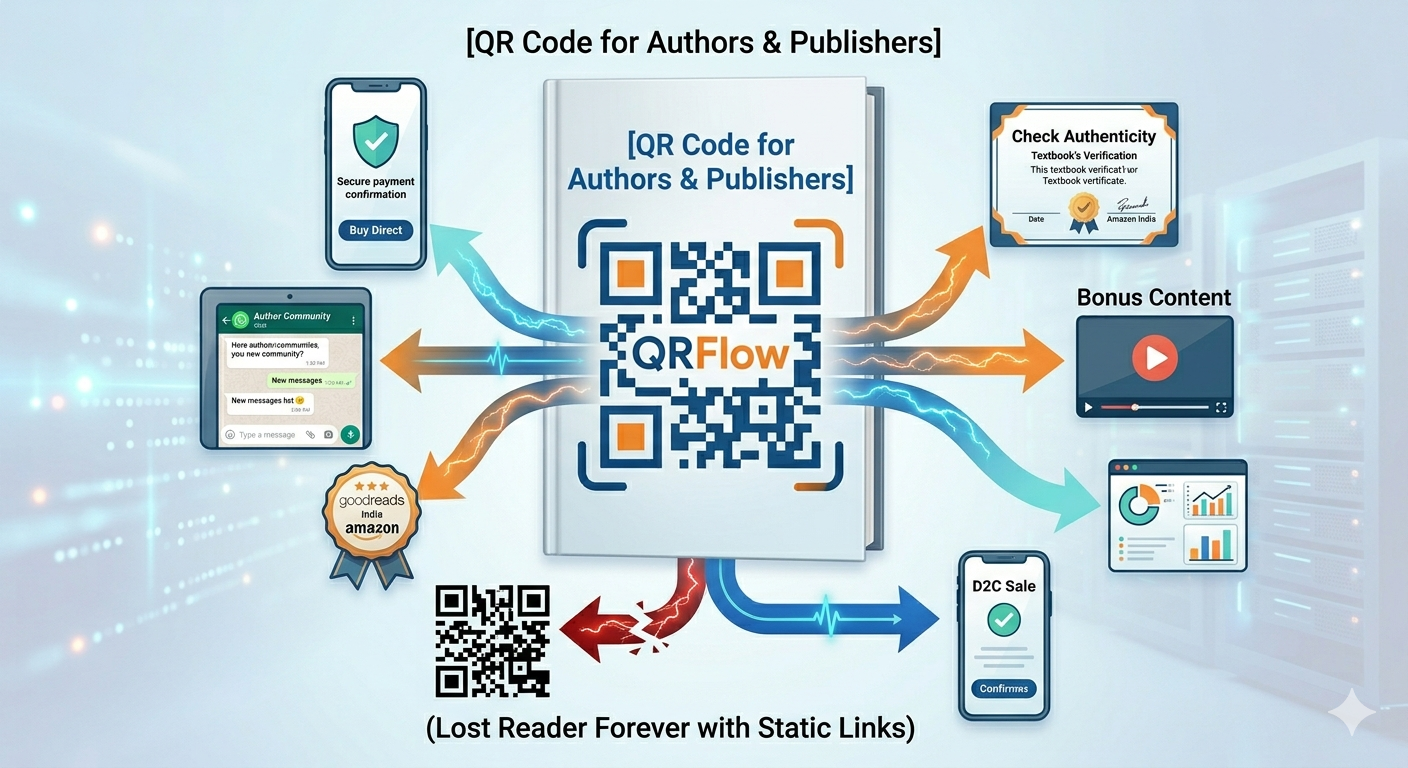
For decades, the relationship between a publisher and a reader ended the moment the book was purchased at a local bookstore like Crossword or shipped via Amazon India. To bridge this gap, authors began printing URLs inside books—inviting readers to "join a newsletter," "download a bonus chapter," or "leave a review."
However, this offline-to-online (O2O) transition is highly fragile. Websites get redesigned, domain names expire, social media handles change, and book distribution partners shift.
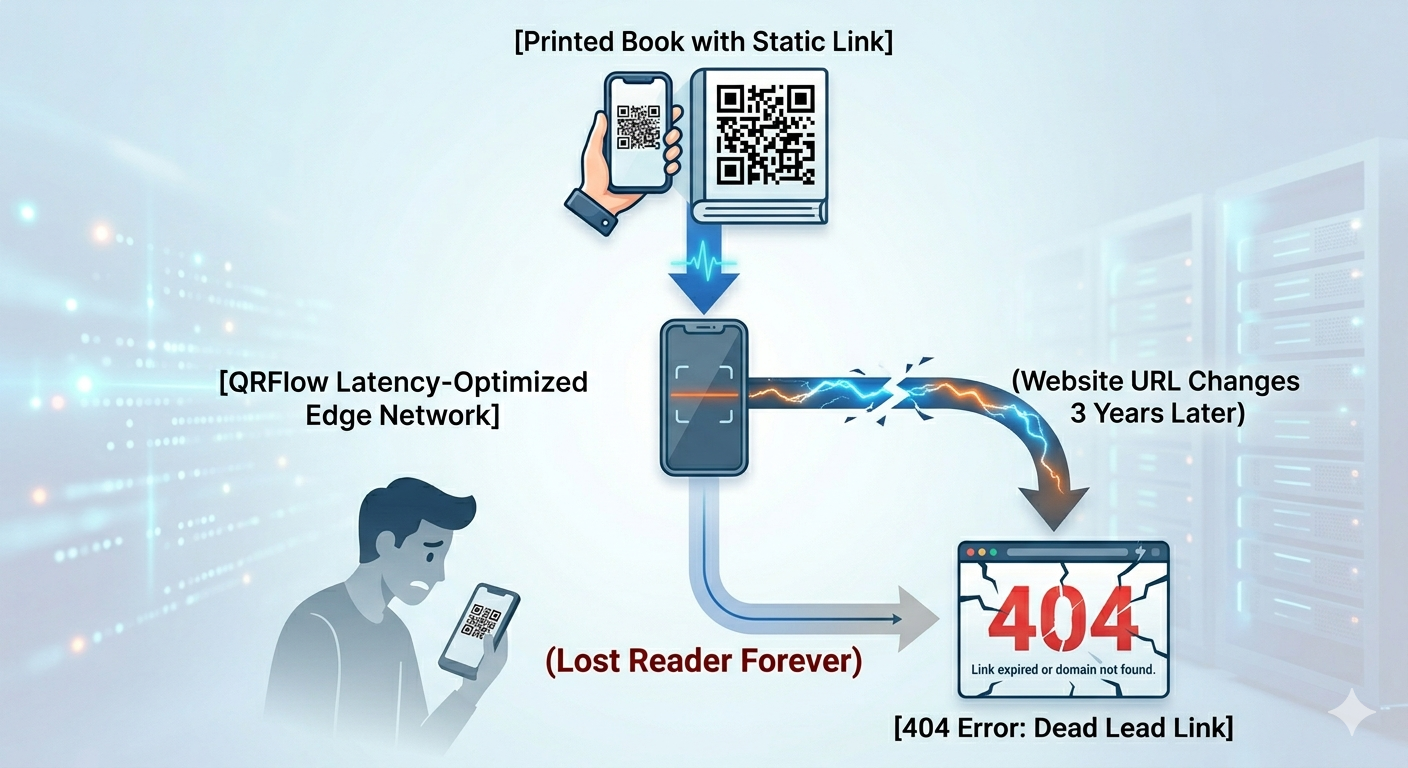
When a static URL printed inside 10,000 physical copies of a paperback breaks, it becomes a dead link. There is no way to recall those books from shelves or readers' homes. The publisher's investment in phygital marketing is instantly lost, resulting in:
- Irreparable Brand Damage: Readers encounter frustrating "404 Page Not Found" errors.
- Wasted Marketing Budget: Zero scan attribution or ROI tracking for offline promotional campaigns.
- Lost Reader Relationships: Missed opportunities to build a direct-to-consumer (D2C) community, leaving publishers entirely dependent on third-party marketplace data.
This is where QRFlow’s dynamic routing infrastructure transforms physical print runs into agile, updateable digital touchpoints.
Static vs. QRFlow Dynamic QR Codes for Publishing
To understand why professional publishers avoid free, static QR code generators, consider the architectural differences under the hood:
| Feature / Capability | Static QR Codes (Free Tools) | QRFlow Dynamic QR Codes |
|---|---|---|
| URL Flexibility | Hardcoded. Once printed, the destination address can never be changed. | Fully editable. Update destination URLs instantly using 301/302 redirection without changing the printed QR pattern. |
| QR Code Density | Higher density. Long URLs make the pattern complex, hard to scan at small sizes on book spines or pages. | Ultra-low density. Uses short, clean redirect paths, ensuring lightning-fast scanning even at tiny print dimensions. |
| Scan Attribution & Analytics | Zero tracking capability. You will never know how many readers scanned your book. | Real-time tracking of scan counts, device types, operating systems (OS), and location (IP-based). |
| Data Privacy Compliance | Often routes through insecure servers with no data privacy guarantees. | Built from the ground up to comply fully with India's DPDP Act 2023. |
| Custom Branding | Basic black-and-white grids with no custom branding or domain masking. | Fully customizable colors, shapes, logos, and custom short-domains for trust. |
6 Deep-Dive Use Cases for Indian Authors & Publishers
Integrating QR codes into books isn't just about linking to a website; it’s about crafting interactive, localized experiences that drive engagement and sales.
1. Direct-to-Consumer (D2C) Book Sales via UPI Integration
With rising distributor commissions on retail platforms, direct sales are crucial for publisher margins. By placing a dynamic QR code on the back cover or bookmark, publishers can route readers to a clean, mobile-optimized checkout page.
- The India Edge: Integrate the destination link directly with instant UPI payment flows (GPay, PhonePe, Paytm). Readers scan, choose their preferred UPI app, and pay securely in seconds for signed copies, merchandise, or the next book in the series.
2. Instant WhatsApp Community Building
Building a reader community is the single best predictor of an author’s long-term success.
- Instead of directing readers to a stagnant email newsletter, place a QR code on the book's final page that opens a WhatsApp Business chat pre-filled with an opt-in message (e.g., "Hi! I just finished reading your novel and would love to join your VIP Readers Club for exclusive updates."). This establishes an instant, high-open-rate communication channel.
3. Dynamic Book Trailers & Rich Media Content
Promoting a sci-fi epic, a cookbook, or a children's book? Print a QR code on the inner flap or introduction page that links to a cinematic video book trailer, an audiobook preview, or an interactive companion guide.
- Because QRFlow uses highly optimized 302 redirection, you can swap the destination URL from a pre-launch YouTube teaser to a post-launch author interview video without altering the book cover files already sent to the printer.
4. Interactive Academic Textbooks (EdTech O2O)
For educational publishers in India, physical textbooks can quickly become outdated.
- By placing dynamic QR codes at the end of chapters, publishers can direct students to mock tests, updated government syllabus files, video lectures, and PDF answer keys. If curriculum guidelines change mid-year, the publisher simply updates the link in the QRFlow Dashboard to keep the textbook current.
5. Seamless Amazon, Flipkart, & Goodreads Reviews
Positive reviews are the lifeblood of book discoverability. Make reviewing frictionless.
- Place a QR code on the postscript page with a call-to-action: "Loved this book? Scan to leave a quick review on Amazon India or Goodreads." Since you can change the target URL at any time, you can dynamically split traffic between Amazon, Flipkart, or Goodreads depending on where you need to boost your search rank that week.
6. Verification of Authenticity & Anti-Counterfeiting
Book piracy and counterfeit printing are major challenges in the Indian market, particularly for academic, engineering, and medical textbooks.
- Publishers can print a unique, dynamic QR code on an inside scratch card or verification page. When scanned, it routes the reader to an official verification portal. This process builds immense brand trust and protects intellectual property.
Technical Superiority: Why QRFlow’s Backend Outperforms Free Tools
For a major publisher executing print runs of 50,000+ copies, technical failure is not an option. A broken redirect or a slow loading time directly translates to lost revenue and damaged reputation. QRFlow provides enterprise-grade infrastructure built for high performance and scale.
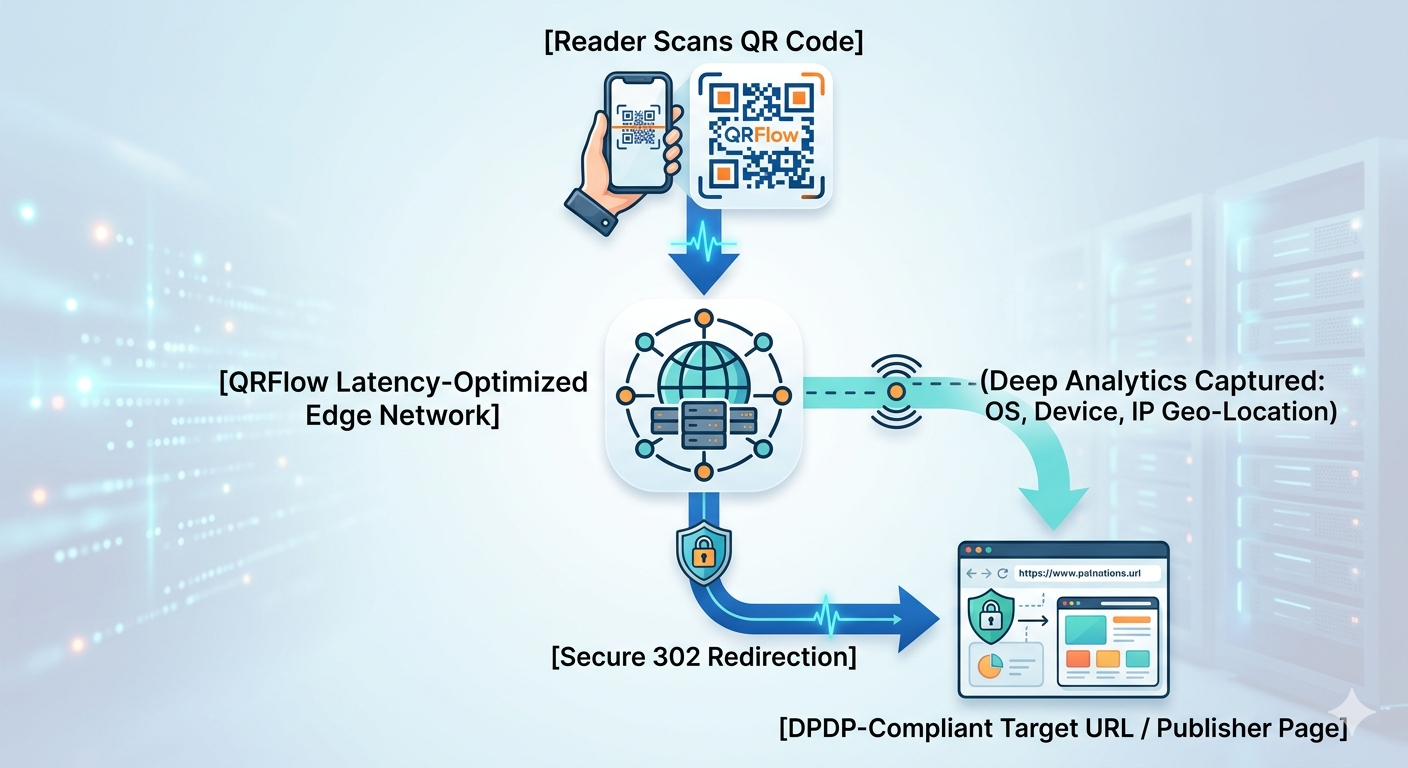
1. Latency Optimization & High-Availability Edge Networks
Every millisecond of delay during a scan increases user drop-off. QRFlow’s redirect engine is built on a globally distributed, low-latency network. When an Indian reader scans a book in Mumbai or Delhi, the redirect is processed at the nearest local edge server, routing them to the destination in under 50 milliseconds.
2. Advanced Scan Attribution & Analytics
Understand your readers with deep, granular insights. QRFlow’s analytics dashboard tracks:
- Device & Operating System: Tailor your landing pages specifically for the mobile browsers your readers use (Android vs. iOS).
- IP-Based Location Tracking: Identify which Indian states or cities are scanning your books most frequently. This data is invaluable for planning offline book-signing tours or targeted local bookstore distribution.
- Time-Series Data: Pinpoint the exact times and days when reader engagement peaks.
3. Brand Security & Managed Redirects
Free QR code generators often use sketchy, third-party domains for their redirect paths. If their domain gets blacklisted by mobile web browsers, your QR code will display a terrifying security warning to your readers. QRFlow uses premium, highly secure redirection domains and allows enterprise publishers to use their own Custom Domains (e.g., links.yourpublisher.com) for ultimate brand security and trust.
4. Strict DPDP Act 2023 Compliance
Under India's Digital Personal Data Protection (DPDP) Act 2023, collecting personally identifiable information (PII) without explicit consent is subject to severe penalties. QRFlow's analytics engine is strictly privacy-first. We track location and device analytics using aggregated, non-PII IP lookup methods, ensuring your campaigns remain 100% compliant with Indian privacy laws while still delivering rich, actionable business insights.
Implementation Guide: Launch Your Dynamic QR Strategy in 3 Steps
Transforming your publishing catalog with dynamic QR codes takes less than five minutes.
Step 1: Register Account ──>
Step 2: Design in Dashboard ──>
Step 3: Print & Track Analytics
Step 1: Register and Setup Your Domain
To get started, visit the QRFlow Sign-Up Page and create your account. If you already have an account, log in at the QRFlow Login Portal. Explore our specialized features on our Features Page to familiarize yourself with the dashboard layout.
Step 2: Design and Customize Your QR Code
In the dashboard, click "Create Dynamic QR." Enter your initial target URL (such as your book’s Amazon India listing or your D2C store).
- Design Customization: Match your book's cover art! Choose custom brand colors, soften the corner eyes, and upload your publishing house's logo directly into the center of the QR code. Ensure there is high contrast between the pattern and background to guarantee optimal print readability.
Step 3: Print and Track Performance
Download your customized QR code in high-resolution vector formats (SVG or EPS) perfect for professional book layout software like Adobe InDesign. Print it on your book covers, bookmarks, posters, or banners. Once printed, check our affordable plans on the QRFlow Pricing Page to make sure your campaign has unlimited scan limits, and watch the real-time reader engagement data flow into your analytics dashboard.
India Business FAQ: Smart Answers for Publishers
Q1. Can we change the destination link of a QR code after the book is printed and sold?
Yes, absolutely. That is the defining power of a dynamic QR code. Because the printed code points to a secure QRFlow redirect link, you can log into the dashboard at any time—even years after publication—and change the final destination URL. Your printed books will instantly point to the new location without any interruption to the reader.
Q2. Is there a scan limit on dynamic QR codes printed on thousands of books?
Free tools often cap your scans at 100 or 500 clicks before disabling your link, which can ruin a major print run. QRFlow's professional and enterprise plans offer highly generous or unlimited scan limits designed specifically for high-volume publishing distributions. To find a plan that matches your print run, visit the QRFlow Pricing Page.
Q3. How do QRFlow codes comply with the Indian DPDP Act 2023?
QRFlow is built with data-minimization principles. Our IP-based location tracking uses secure, aggregated database lookups that do not store personal coordinates or track individual reader identities over time. This provides you with highly accurate geographic data (down to the state and city level) while fully protecting your readers' digital privacy.
Q4. Can we use our own custom domain for the QR codes to build trust?
Yes. To avoid using generic redirect links, enterprise publishers can map their own sub-domain (e.g., scan.yourpublishingbrand.in) to QRFlow. This ensures that when a reader scans the code, they see your trusted brand name in their mobile browser's address bar instantly, maximizing scan confidence.
Q5. We print books on uncoated, recycled paper. Will the QR codes still scan?
Yes, but you must follow print best practices. Always ensure there is a strong color contrast (e.g., deep dark blue, dark brown, or black codes on a crisp white or cream background). Avoid light or pastel colors for the QR pattern. Download the vector SVG format from the QRFlow dashboard to prevent any pixelation during the printing process.
Ready to Elevate Your Publishing Strategy?
Don't let your printed books become offline dead-ends. Take complete control of your reader journey, capture valuable market analytics, and supercharge your book sales with the industry's most robust dynamic QR infrastructure.
- To begin your journey, Sign Up for QRFlow today.
- Have specialized bulk printing requirements or need enterprise integration? Contact our Indian Support Team for a tailored solution.