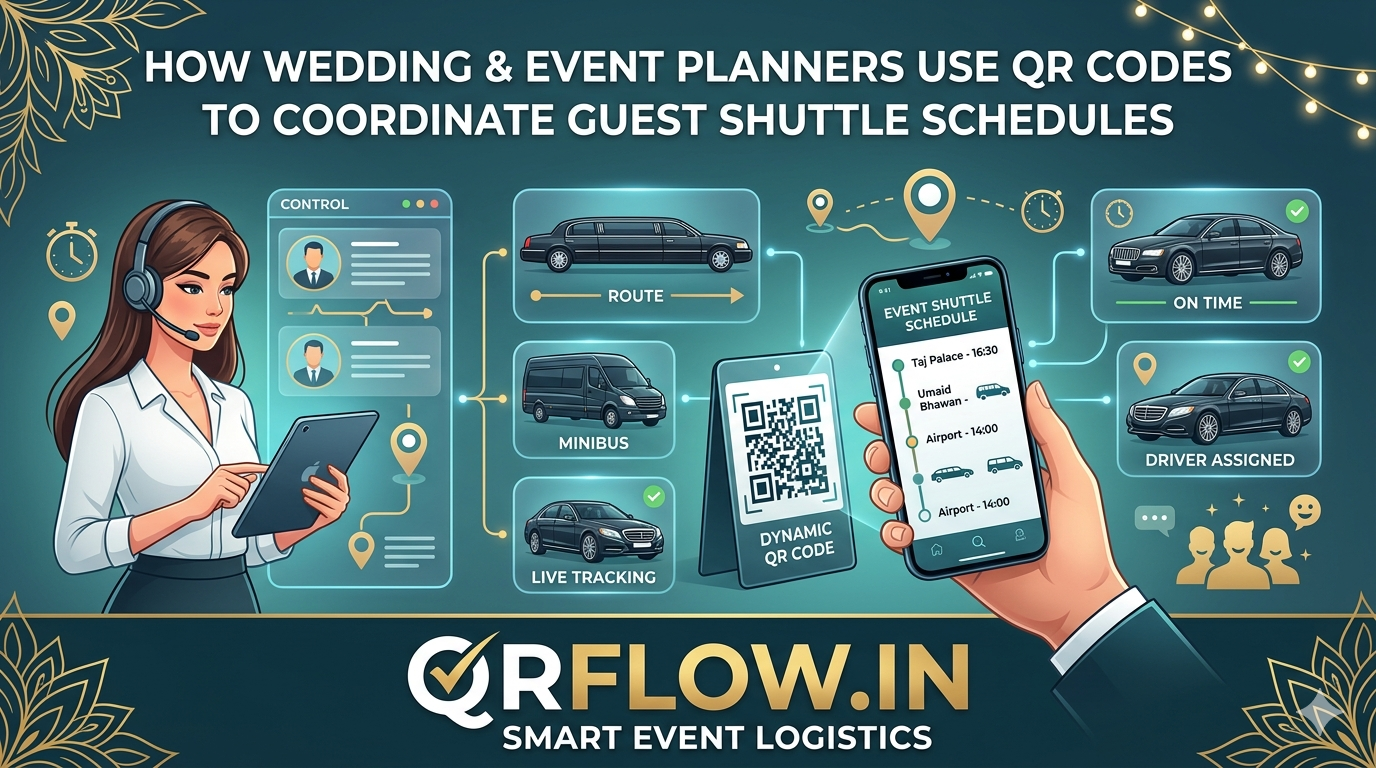
In the fast-paced world of Indian luxury weddings (often spanning multiple days across palaces, resorts, and banquet halls) and high-stakes corporate conventions, transportation is the invisible spine of guest satisfaction. Traditionally, planners have relied on printed itineraries placed in welcome kits or static PDFs broadcasted via broadcast groups.
However, real-time events are volatile. Flights get delayed at Chhatrapati Shivaji Maharaj International Airport (BOM) or Indira Gandhi International Airport (DEL); traffic snarls in Bengaluru alter pickup times; or a Sangeet ceremony at a heritage fort runs two hours late.
If your transport itinerary relies on a printed document or a fixed link, a single schedule change renders your entire collateral network obsolete. This is the high cost of "Dead Links" in physical marketing and operations. When a link fails or displays outdated information:
- Guests miss their designated shuttles, leading to frustration and fragmented arrivals.
- Event desks are inundated with frantic phone calls and messages, overwhelming the hospitality desk.
- Transport planners incur massive overhead costs scrambling emergency backup fleets (Innova Crystas or luxury coaches) at premium, last-minute spot rates.
By transitioning to dynamic, managed infrastructure, event planners can execute real-time updates seamlessly behind the same physical QR code, saving operational costs and preserving executive brand reputation.
Technical Comparison: Static vs. QRFlow Dynamic QR Codes
To understand why traditional, free QR code generators fail under operational pressure, we must look at how data is structured within the matrix.
A Static QR Code embeds the destination URL directly into the pixel pattern. The more data you encode (e.g., a long Google Maps link or a dense PDF URL), the denser and more complex the QR code grid becomes. This drastically increases scanning latency and reduces readability in low-light environments (like evening wedding entries). Crucially, static codes cannot be edited once printed. If your document link changes, your printed materials are ruined.
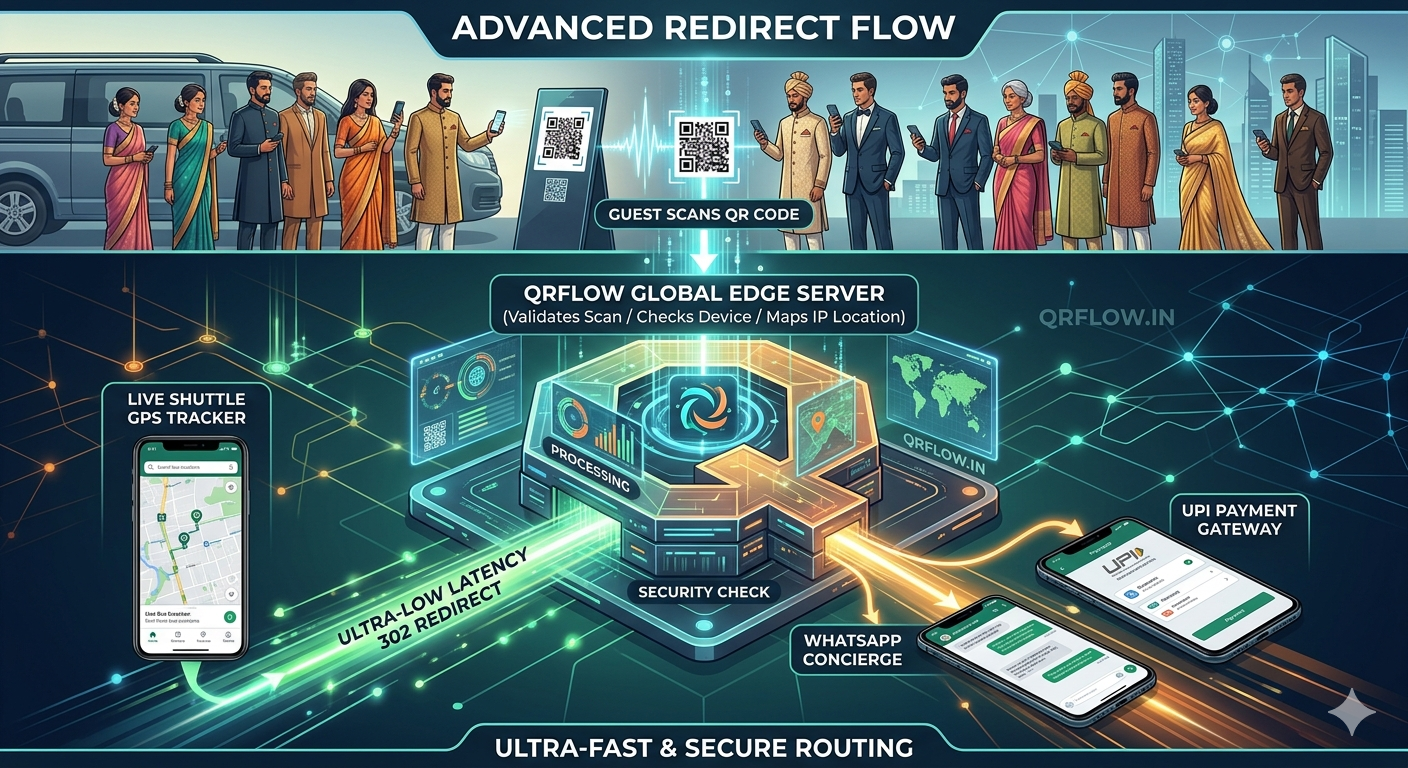
A QRFlow Dynamic QR Code embeds a short, lightweight placeholder URL pointing to a secure routing server. When a guest scans the code, the server executes a rapid server-side redirect to the target destination. This architecture delivers smaller pixel density, instantaneous scans, complete data mutability, and deep analytics.
| Feature / Metric | Static QR Codes | QRFlow Dynamic QR Codes |
|---|---|---|
| URL Editability | Permanent. Cannot be altered after printing. | 100% Mutable. Update destination links instantly without re-printing. |
| Redirection Technology | Hardcoded direct path. | Secure 301/302 Redirection engine with zero downtime. |
| Scan Attribution & Analytics | Zero tracking capability. | Real-time tracking: Device OS, Browser, and IP-based Location. |
| Visual Matrix Density | Complex, dense grid (Hard to scan in low light). | Clean, low-density micro-matrix (Optimized for quick scans). |
| O2O Attribution & Conversion | Completely blind Offline-to-Online loop. | Precise attribution metrics for event engagement and vendor performance. |
| Phygital Marketing Integration | Limited to single-use landing pages. | Adaptable ecosystem for WhatsApp, UPI, maps, and schedules. |
5 Deep-Dive Use Cases for the Indian Event Transport Ecosystem
1. Dynamic Shuttle Trackers for Destination Weddings
Destination weddings in locations like Udaipur, Goa, or Jaipur involve moving hundreds of guests across hotels, airports, and venues. Planners can place custom-branded QR codes on vehicle windows, driver dashboards, and hotel lobby standees. By linking these codes to dynamic routing configurations, planners can alter the destination URL throughout the 3-day event. On Day 1, the code directs guests to the airport pickup roster; on Day 2, it transforms into a live GPS tracking link for buses heading to the Mehendi venue; on Day 3, it opens the late-night Baraat shuttle schedule.
2. Hyper-Localized UPI Driver Tipping & Payments
In India’s rapidly evolving cash-free economy, processing fast payments for auxiliary transport staff, valets, and drivers is vital. Planners can deploy dynamic QR codes that seamlessly trigger UPI payment flows natively inside apps like Google Pay, PhonePe, or Paytm. Instead of managing cash advances for toll clearances, fuel refills, or driver allowances, logistics managers can update the backend parameter to point to designated merchant accounts, securing transparent financial tracking.
3. Native WhatsApp Business Concierge Routing
When guests face localized transit issues, they need immediate human assistance rather than an automated email form. By designing a dynamic QR code that maps directly to a WhatsApp Business integration, scanning the code auto-opens WhatsApp on the guest's smartphone with a pre-filled, context-aware text message (e.g., "Hi, I am a guest at the Mehta Wedding and I need assistance with the current shuttle at Hotel Taj Lake Palace"). This allows the hospitality control room to triage requests instantly based on scan origin.
4. VVIP Digital Luggage & Fleet Tagging
Managing luggage handoffs from airport arrivals to specific resort villas is a major operational risk. By using rugged, serialized tags utilizing GS1 Standards data formatting embedded within QRFlow matrices, logistics teams can track luggage carts and dispatch vehicles. If a guest’s baggage is misrouted, scanning the assigned vehicle tag immediately pulls up the manifest, ensuring fast resolution and ironclad digital chain of custody.
5. Corporate Convention Transit & O2O Attribution
For massive trade shows or corporate annual general meetings (AGMs) at venues like Bharat Mandapam (IECC) or Jio World Convention Centre, moving delegates across corporate hubs requires precise scheduling. Planners can monetize the transit experience by displaying sponsor ads on bus headrests with QR codes. Using O2O (Offline-to-Online) Attribution, the platform measures exactly which bus route, timing, or sponsor banner generated the highest engagement, providing clean data-driven ROI reports to brand sponsors.
The Technical Advantage: Why QRFlow Beats Free Alternative Tools
Planners running mission-critical operations cannot afford the performance bottlenecks of free, consumer-grade QR generators. QRFlow is architected specifically for corporate compliance, enterprise scale, and ultra-low latency.
Server-Side Latency Optimization
When hundreds of guests exit a concert hall or a wedding venue simultaneously, network towers experience extreme congestion. Free QR tools route users through heavily shared, unoptimized ad servers, causing slow loading times or outright request timeouts. QRFlow utilizes global Latency Optimization protocols alongside highly responsive edge hosting. This guarantees that server-side redirects resolve within milliseconds, even on congested 4G/5G Indian cellular networks.
Brand Protection via Managed Redirects
Free QR tools often monetize their free tiers by injecting interstitial third-party banner ads or tracking scripts during the routing process. This exposes high-net-worth event guests to security risks, data harvesting, or inappropriate advertisements. QRFlow provides completely clean, unbranded, managed redirects. Your data routes directly to your target destination with no external scripts, preserving total brand integrity and security.
Comprehensive Analytics Engine
QRFlow’s dashboard turns physical touchpoints into clean digital data streams. For every scan, the system records:
- Device & OS Attribution: Optimize your layout designs for iOS vs. Android.
- IP-Based Location Profiling: Track exactly which hotels or terminal zones are generating the highest pickup demands.
- Scan Distribution Over Time: Identify peak transit bottlenecks to dynamically adjust your fleet dispatch intervals.
Compliance with India's DPDP Act 2023
With the enforcement of the Digital Personal Data Protection (DPDP) Act 2023 in India, collecting corporate or personal guest data without explicit consent carries severe penalties. QRFlow respects privacy by design. Our analytics suite captures high-level technical parameters (Device, OS, generalized IP locations) without harvesting Personally Identifiable Information (PII) like phone numbers, names, or exact coordinates unless explicitly consented to by the user via integrated opt-in workflows.
Step-by-Step Implementation Guide for Transport Planners
Deploying a comprehensive transport tracking network takes under five minutes using the unified QRFlow enterprise dashboard.
- Register and Setup: Visit the QRFlow Sign Up Page to create your workspace. If you already have an account, securely access your dashboard via the QRFlow Login Interface.
- Configure Design & Destination: Navigate to the generation panel. Enter your initial destination target (e.g., your real-time Google Maps fleet tracking link or a shared digital itinerary spreadsheet). Customize the aesthetic elements—apply brand colors, embed your event logo, and select clean custom frames. Review the advanced performance capabilities detailed on the QRFlow Features Platform to maximize scan readability under difficult environmental lighting.
- Deploy, Print, and Monitor: Download your finalized high-resolution asset in vector format (SVG/EPS) for crisp large-scale printing on vehicle vinyls, welcome standees, and badges. During the event lifecycle, monitor your active data feeds via the real-time analytics window. If a route changes or a vehicle changes mid-day, simply edit the destination path instantly from your smartphone without replacing any physical collateral.
India Business FAQ: Strategic & Technical Insights
Q1: Is there a hard limit to the number of scans a dynamic QR code can handle during a massive multi-day festival?
Unlike restrictive free tools that freeze operations once a specific monthly scan threshold is crossed, QRFlow’s enterprise architecture supports unlimited scalability. Our infrastructure is built to absorb massive concurrent scanning surges without performance degradation or service lockouts. To select a plan tailored to your event scale, explore our tiered options on the QRFlow Pricing Guide.
Q2: How do dynamic QR codes comply with India’s DPDP Act 2023 regarding guest data protection?
QRFlow uses a privacy-first analytics pipeline. We track non-identifying parameters such as device configurations, browser frameworks, and broad network locations. Because we do not store, exploit, or transmit direct personal identifiers without explicit consent, your event operations remain fully aligned with the strict statutory compliance criteria of the Digital Personal Data Protection Act.
Q3: Can we generate automated tax invoices with GSTIN compliance for corporate event budgeting?
Yes. Every commercial subscription tier processed via our platform supports comprehensive Indian billing requirements. You can easily input your organization's legal trading name and valid GSTIN during checkout to generate clean, automated tax invoices for corporate input tax credit compliance.
Q4: What happens if a vehicle is reassigned or an itinerary changes last-minute? How long does a URL update take?
The routing transition occurs instantly at the server level. The exact moment you hit save inside the dashboard, our network applies a secure 301/302 redirection modification globally. Guests scanning the physical asset even a second later will instantly land on the newly assigned link, eliminating the risk of displaying broken or outdated operational parameters.
Q5: Can we integrate custom branded domains instead of utilizing standard short-links?
Yes. Enterprise accounts can easily configure custom white-label short domains (e.g., go.yourbrand.in). This increases user trust, reinforces premium brand positioning, and ensures that the entire digital touchpoint remains anchored to your unique corporate identity. For specialized technical integration setups or custom deployment requests, connect directly with our engineering team via the QRFlow Official Contact Page.