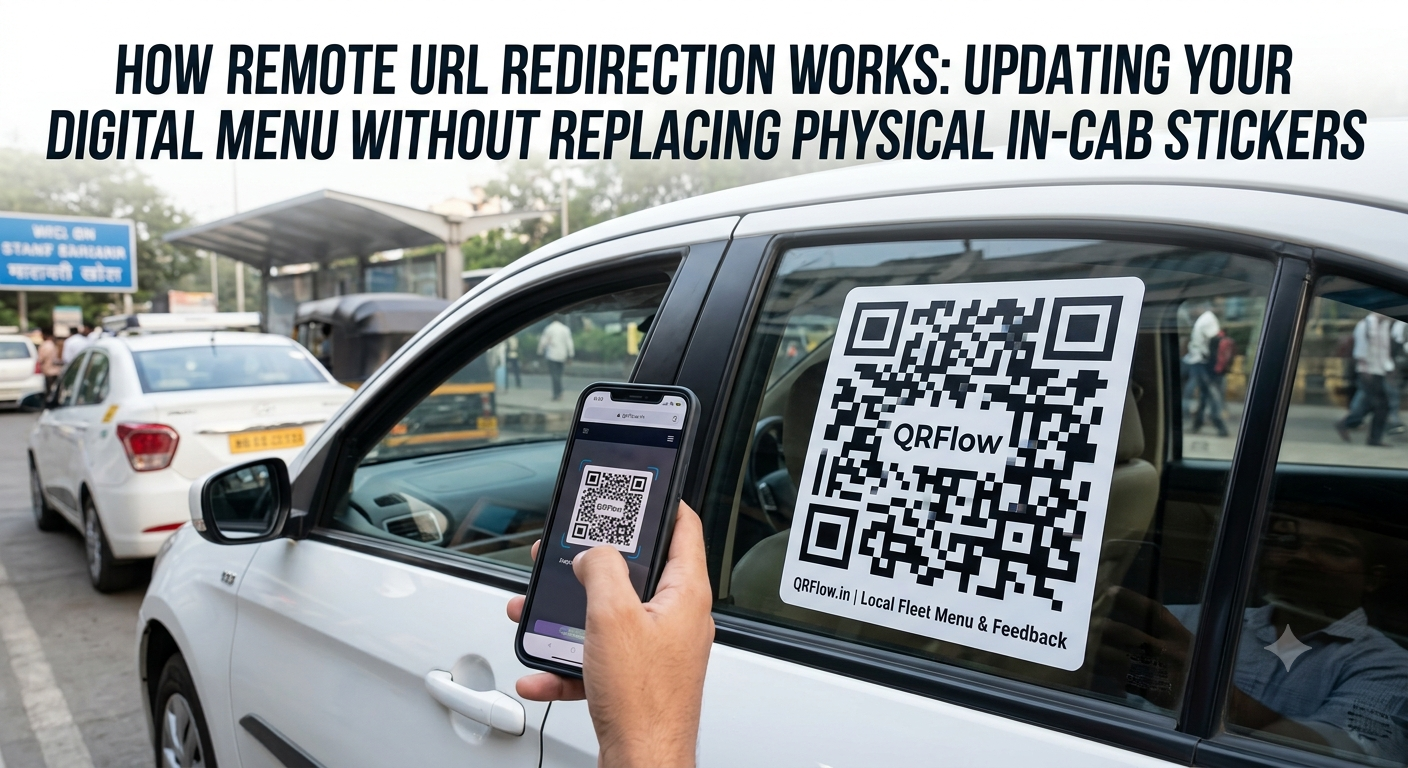
Physical marketing collateral in high-mobility industries like ride-hailing fleets, interstate bus networks, and food delivery vehicles represents a substantial capital investment. When an Indian logistics operator or cab aggregator prints and applies thousands of vinyl QR code stickers across a fleet, those stickers become immutable hardware endpoints.
If your backend URL structure changes, your promotional campaign ends, or your digital menu update fails, you face the High Cost of Dead Links. In India's hyper-competitive mobility and service sectors, replacing 5,000 vinyl decals across a fleet distributed across cities like Mumbai, Bengaluru, and Delhi leads to significant physical reprinting fees, vehicle downtime, and lost offline-to-online (O2O) conversion revenue.
Static vs. Dynamic QR Code Architecture
Understanding why physical stickers fail requires looking at the underlying data structure of a QR matrix.
A Static QR Code bakes the destination target directly into the data modules of the code. The longer the target URL, the denser and more complex the visual pattern becomes—making it harder for budget smartphone cameras to scan under poor lighting conditions.
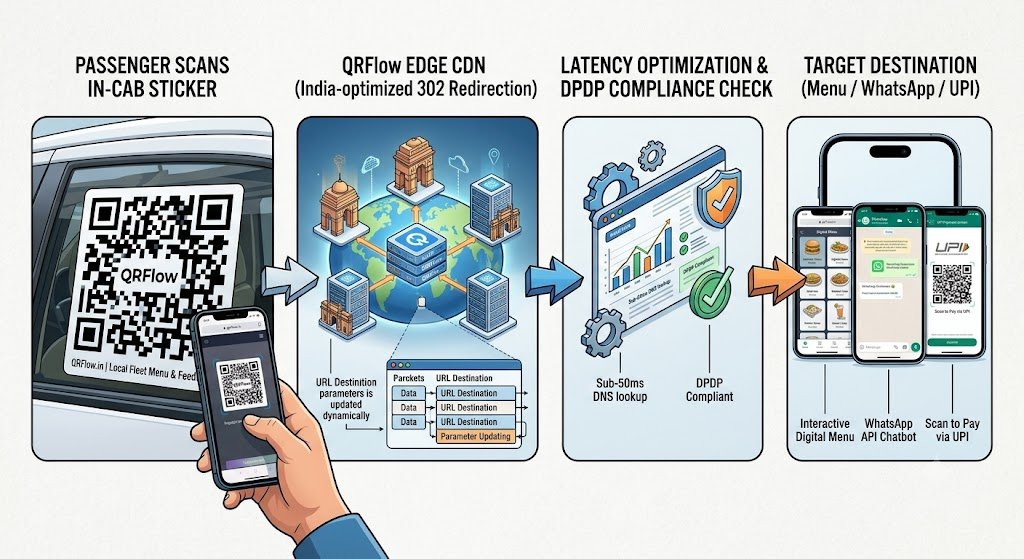
A Dynamic QR Code powered by QRFlow, on the other hand, encodes a lightweight, static short domain payload. When a user scans the sticker, the request hits QRFlow’s edge routing tier, which instantly resolves the destination using server-side redirection rules.
| Feature / Metric | Static QR Codes | QRFlow Dynamic QR Codes |
|---|---|---|
| URL Encoding | Direct Hardcoded URL | Managed Short Domain Payload |
| Destination Editability | Permanent (Requires physical reprinting) | Real-Time Remote Redirection (Zero reprinting) |
| HTTP Routing Mechanism | Direct Client Navigation | Managed Server-Side 302 / 307 Redirection |
| Scan Analytics & Attribution | None (Zero visibility) | Full Device, OS, Geo-Location & Time Attribution |
| Phygital Security | High risk of static URL hijack / dead link | Enterprise Domain Shield & Malicious Link Protection |
| Data Privacy Compliance | Unregulated | DPDP Act 2023 & Anonymized Analytics Engine |
| Dynamic Routing Rules | Unavailable | Geo-location, Device OS & Time-based conditional logic |
Technical Deep-Dive: How Remote URL Redirection Beats Free Tools
When evaluating dynamic QR code engines, backend infrastructure dictates campaign reliability, scan response rates, and enterprise data protection.
1. HTTP 302 Managed Redirection vs. HTTP 301 Caching
Free or unmanaged QR generators often issue HTTP 301 (Permanent) redirects. Mobile browsers aggressively cache 301 responses locally on the user's device. If you update your digital menu URL on the backend, existing customers who previously scanned the in-cab sticker will continue loading the old cached menu from their device storage.
QRFlow utilizes optimized HTTP 302 (Temporary) / 307 Redirects. This instructs mobile browser webviews (Safari, Chrome, Samsung Internet) never to store a permanent cache of the target destination, ensuring that URL updates in your QRFlow Dashboard take effect instantly across all active physical stickers nationwide.
2. Edge Latency Optimization across Indian Telecom Networks
Scanning a QR code in a moving cab means operating under variable cellular connectivity (switching between 5G, 4G LTE, and weak 3G corridors). QRFlow leverages high-performance edge routing infrastructure deployed within Indian data centers. By performing sub-50ms lookup times, QRFlow ensures the passenger experiences instantaneous page renders rather than long loading screens.
3. Analytics Attribution without Privacy Violations (DPDP Act 2023)
India's Digital Personal Data Protection (DPDP) Act 2023 imposes strict guidelines on capturing identifiable user information without explicit consent. Standard tracking links that fingerprint personal identifiable information (PII) put Indian businesses at regulatory risk.
QRFlow delivers comprehensive Scan Attribution (capturing Device Type, Operating System, City-level IP Location, and Time-of-Day trends) while utilizing privacy-first hash-anonymization. You gain actionable O2O attribution without capturing or storing personal data in violation of DPDP mandates.
4. Brand Security and Malware Defense
Static QR codes displayed in public spaces like taxis or delivery bays are vulnerable to physical swapping or link spoofing. QRFlow provides domain shielding and real-time destination health checks. If a target URL suffers a server outage or SSL certificate expiration, QRFlow allows fallback routing to a backup destination, protecting your brand reputation.
7 Enterprise Use Cases for the Indian Market
1. In-Cab Fleet Monetization: Updating Passenger Services & Menus
Cab aggregators and private fleet operators equip vehicle backrests with laminated QR stickers. Through Remote URL Redirection, the operator can serve an interactive breakfast snack menu and tea ordering page during morning airport runs (6 AM – 11 AM), and dynamically update the redirect target to a late-night OTT entertainment subscription portal or hotel booking page after 8 PM—all without touching the physical sticker.
2. Direct WhatsApp Business API Routing for Fleet Support
Instead of printing fixed support numbers that change over time, fleet stickers can resolve to dynamic WhatsApp Business links (wa.me). If your customer support infrastructure migrates from an automated chatbot to a live agent desk, update the target routing parameter in your QRFlow Account instantly to maintain seamless customer communication.
3. Contextual UPI Payment Flows for On-Demand Cab Services
Dynamic QR codes integrated into physical receipt displays or driver headrests can direct users to a dynamic checkout page pre-configured with Unified Payments Interface (UPI) intent links (upi://pay). If your business changes payment gateway providers (e.g., migrating between Razorpay, Cashfree, or PayU), simply update the destination endpoint on QRFlow without changing the printed QR assets.
4. Inter-City Bus Fleet Digital Catalogs & Micro-Ticketing
Long-distance bus operators across India utilize seat-back QR codes to showcase snack menus, downstream leg bookings, and tourist attraction packages. Operators can alter the linked landing page based on the vehicle's active route (e.g., Mumbai to Pune vs. Bengaluru to Chennai) straight from the centralized dashboard.
5. Quick Service Restaurant (QSR) Counter & Delivery Packaging
Food brands attaching QR packaging stickers can pivot promotional offers daily. On weekdays, the QR code points to a "10% Off Lunch Combo" menu; on weekends, it automatically switches to a high-ticket "Family Feast" ordering portal, driving maximum average order value (AOV) per scan segment.
6. GS1-Standard Compliant Logistics & Parcel Tracking
Logistics companies printing shipping labels can encode dynamic identifiers compatible with 2D barcode migration standards. Scans by warehouse operations route to internal inventory ERP systems, while consumer scans on the same parcel redirect to an outward-facing delivery tracking page.
7. Phygital Marketing Campaigns for Retail Pop-Ups & Auto Expos
Automobile brands exhibiting at trade shows can paste dynamic QR decals on vehicle windows. During the event, the QR code links to a 360-degree virtual test-drive booking experience. Post-event, the exact same sticker redirects prospective buyers to their nearest local dealership locator.
Implementation Guide: 3 Steps to Remote URL Redirection
Setting up dynamic redirection for your physical collateral takes less than five minutes:
Step 1: Account Registration & Domain Setup
Create your organization profile on the QRFlow Registration Page. Select your plan based on scan volume needs by reviewing QRFlow Pricing. Connect your custom brand domain (e.g., qr.yourbrand.in) to ensure full brand trust during scan redirects.
Step 2: Design & Export High-Resolution Vectors
Navigate to the QRFlow creator studio. Customize your matrix design with your brand’s hex colors, logo overlay, and error-correction levels (High/Q-level to survive scratches on vinyl stickers). Download the vector output (SVG/EPS) for high-DPI physical printing.
Step 3: Deploy Stickers & Manage Redirect Rules Remotely
Apply your vector stickers to your fleet or physical touchpoints. Log in to the QRFlow Control Panel anytime to modify destination URLs, view device analytics, run A/B split tests, or establish time-based redirection rules without reprinting a single piece of paper.
Frequently Asked Questions (FAQ)
1. Will updating the destination URL change the visual pattern of my printed QR code?
No. Dynamic QR codes encode a fixed, ultra-short redirection URL hosted on QRFlow. The visual matrix remains 100% identical regardless of how many times you update the underlying destination URL in the dashboard.
2. Is QRFlow fully compliant with India's DPDP Act 2023?
Yes. QRFlow's analytics engine operates on an anonymized attribution model. We process non-personal data (device operating system, browser type, cellular carrier, and city-level geofencing) without capturing personal identifiers or tracking users across un-associated web properties.
3. How does QRFlow handle high scan volumes during peak marketing campaigns?
QRFlow runs on distributed server infrastructure with sub-50ms latency optimization. Whether your fleet stickers generate 1,000 or 1,000,000 scans per day, our automated edge routing prevents bottlenecks and service interruptions.
4. Can I issue GST-compliant invoices for corporate tax deductions in India?
Yes. All paid subscriptions on our Pricing Page generate tax-compliant GST invoices featuring your company’s GSTIN for seamless input tax credit (ITC) claims.
5. What happens if my target website goes down temporarily?
Unlike static QR codes that display a broken webpage, QRFlow allows you to set fallback redirect rules. If your primary site experiences downtime, traffic can automatically route to an alternate landing page or a WhatsApp support channel. For custom enterprise configurations, reach out through our Contact Page.