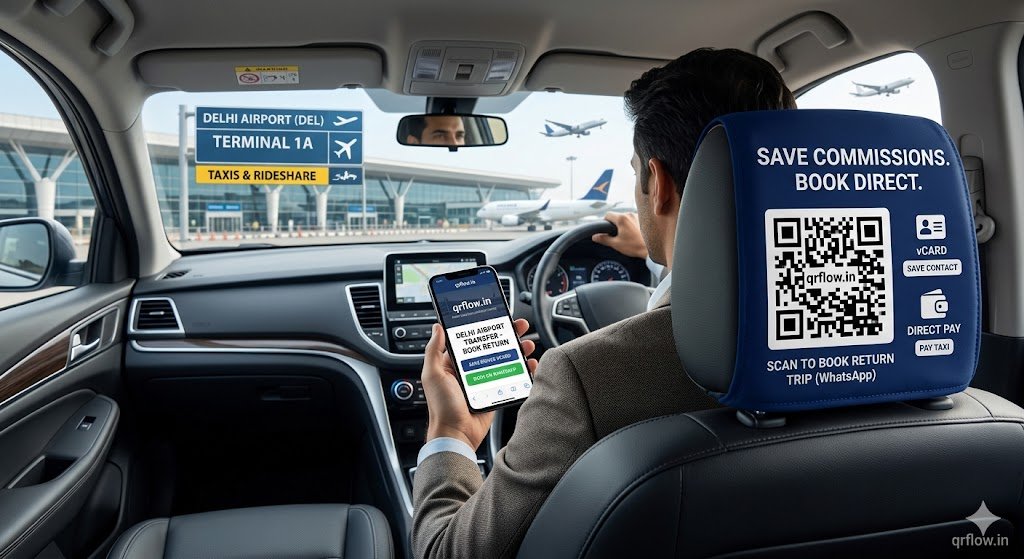
Airport runs are the lifeblood of independent transport operators and boutique fleet owners. However, the financial reality behind these high-ticket trips is often bleak. A driver might secure a premium fare from a city center to the airport, only to face an empty return leg—or worse, a return trip heavily cannibalized by ride-hailing platforms.
To bridge this gap, forward-thinking airport taxi drivers are turning to a brilliant physical-to-digital growth hack: the In-Cab QR Code. By placing a single, dynamic QR code on the passenger headrest or dashboard, operators are turning captive transit time into a frictionless engine for direct, repeat bookings.
The Problem Statement: The Commission Drain and the "Empty Return" Dilemma
Independent operators and fleet managers face two critical operational friction points that severely bottleneck their profitability:
- Aggregator Commissions: Major ride-hailing platforms take a 20% to 35% cut on every trip. For an airport transfer, this means a massive chunk of the margin goes to a middleman who owns the customer relationship.
- The Customer Retention Gap: When a tourist or business traveler experiences excellent service, a clean vehicle, and a safe drive, they are highly likely to rebook that same driver for their return trip or future visits. However, exchanging paper business cards is an archaic, low-conversion practice. Cards get lost in wallets, and manual number-saving introduces friction.
Without a seamless way to capture that customer's intent in transit, the driver loses the lead, and the passenger falls back into the aggregator app ecosystem.
The Physical-to-Digital Loop: One QR Code, Multiple Digital Intents
The modern solution relies on closing the gap between the physical ride experience and a digital ecosystem. Smart operators don't redirect passengers to a clunky website with long lead-capture forms. Instead, they use a dynamic micro-landing page hub like qrflow.in to trigger immediate, native smartphone actions.
[Passenger Scans Headrest QR]
│
├──► Intent 1: "Save My Contact" ──► Instant vCard Download
├──► Intent 2: "Book Return Leg" ──► WhatsApp Automation / Direct Booking
├──► Intent 3: "Pay Instantly" ──► Contactless Payments (UPI/Stripe)
└──► Intent 4: "Leave Feedback" ──► Smart Feedback Filter
When a passenger scans the single in-cab QR code during their 45-minute airport commute, they are presented with an intuitive interface that elegantly handles multiple touchpoints:
- Instant vCard Download: A single tap downloads the operator's official business contact details directly into the passenger's phone book, securing long-term driver independence.
WhatsApp Automation: Instead of forms, a "Book Return Journey" button opens WhatsApp with a pre-filled text template.
"Hi, I am currently riding in vehicle [Vehicle_No]. I'd like to check availability to book my return airport pickup on [Date] at [Time]."
- Contactless Payments: Integrates secure native UPI intents or digital wallets, bypassing platform escrow delays and ensuring immediate cash flow.
- Smart Feedback Filter: Protects public reputation by routing five-star ratings directly to Google Business Profiles, while filtering negative feedback internally to the fleet manager via a private submission form.
Financial Impact: Before vs. After In-Cab QR Architecture
By bypassing third-party aggregators and capturing the return leg directly, the unit economics of a single airport vehicle shift dramatically.
| Financial & Operational Metric | Old Way (Aggregator & Paper Cards) | New Way (Direct via qrflow.in) |
|---|---|---|
| Platform Commission | 25% to 35% per trip | 0% (Direct to Driver) |
| Customer Retention Rate | < 3% (Lost business cards) | 28% to 42% (vCard & WhatsApp) |
| Return Leg Utilization | 40% (Often driving back empty) | 75%+ (Pre-booked return legs) |
| Payment Settlement | Weekly payout minus platform fees | Instant via Contactless Payments |
| Review Acquisition | Controlled by platform algorithm | Direct to Google Business Profile |
The Math Behind the Margin
Consider an independent tourist cab operator charging a flat $60 for an airport transfer, running 20 days a month, doing 2 airport runs a day.
$$\text{Aggregator Model Net Profit Margin} = (\text{Fare} \times \text{Trips}) - \text{Commission (30\%)} - \text{Fuel/Opex}$$
$$\text{Direct Booking Net Profit Margin} = (\text{Fare} \times \text{Trips}) - \text{Fuel/Opex}$$
By utilizing qrflow.in to convert just 15 out of 40 monthly trips into direct bookings, a fleet manager reclaims hundreds of dollars per vehicle that would have otherwise vanished into aggregator fees, while simultaneously booking out empty return legs well in advance.
Streamlining the Workflow with qrflow.in
Deploying this infrastructure requires zero coding knowledge or expensive software suites. qrflow.in provides transport operators with a highly specialized, lightweight dashboard designed exactly for the mobility sector.
- Generate the Fleet Hub: Fleet managers configure a dynamic micro-page for each vehicle, linking the specific driver’s WhatsApp, vCard, and payment gateways.
- Deploy the Physical Asset: Print and place high-quality, branded QR code stickers or acrylic stands on the passenger-facing headrest patches.
- Automate the Capture: While en route, the passenger scans, saves the contact info, and schedules their direct booking return flight pickup smoothly.
In an industry where margins are constantly squeezed by global tech giants, building your own entity-based digital ecosystem right inside your physical asset is the ultimate strategy for sustainable growth.