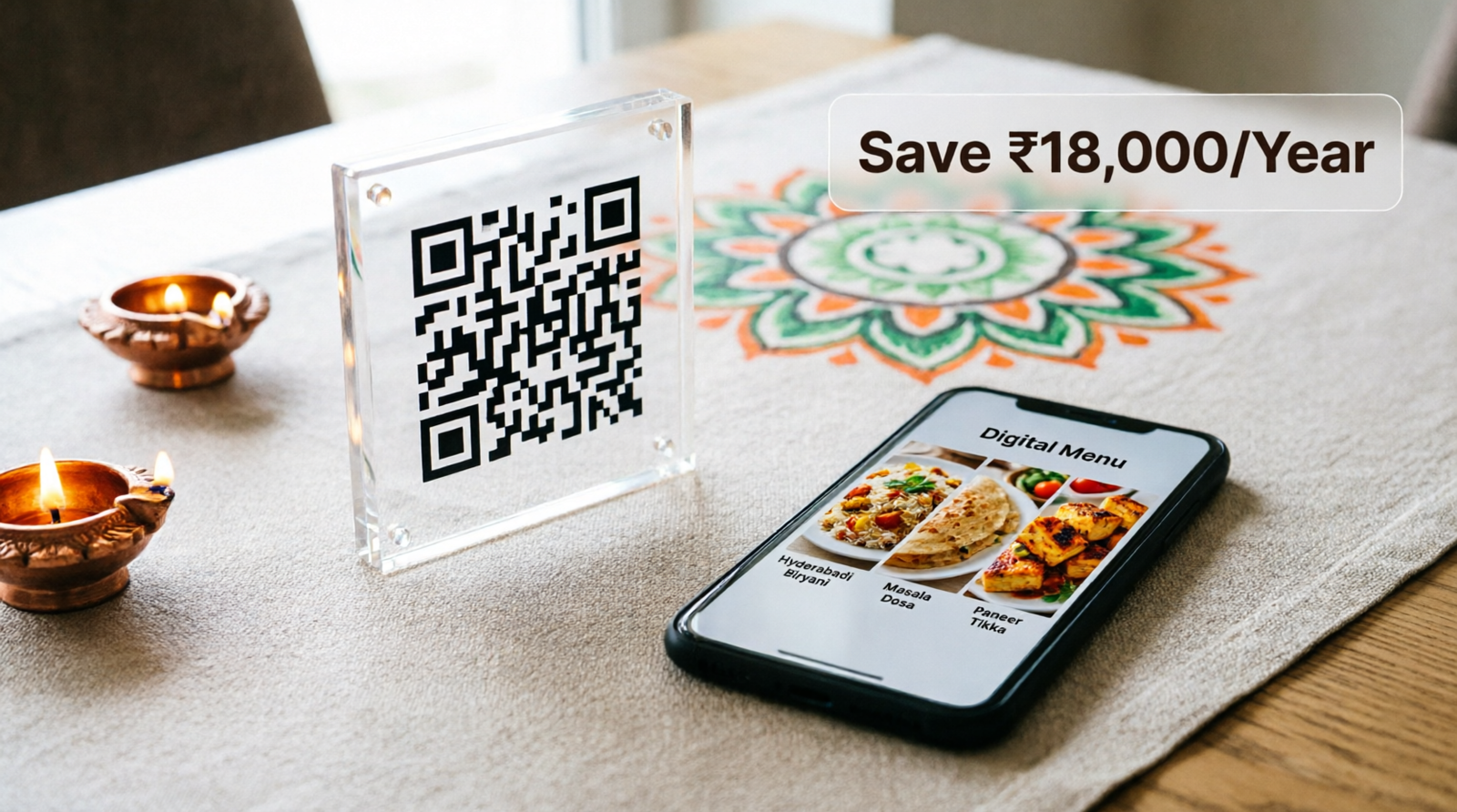
Running a restaurant in India means constantly balancing quality, service, and costs. Yet, one expense that keeps creeping up year after year is menu reprints. Whether it's Diwali specials, monsoon offers, or sudden price changes due to GST adjustments, traditional printed menus cost Indian restaurants an average of ₹15,000-₹25,000 annually—money that could be better spent on ingredients or staff training.
During the festive season of 2025, we tracked over 200 restaurants across Pune, Mumbai, and Bangalore who reprinted their menus 3-4 times just to accommodate festival specials and seasonal items. That's not just wasteful—it's unsustainable for small and medium restaurants operating on tight margins.
This comprehensive guide shows you exactly how to implement a QR code menu restaurant India solution that eliminates reprint costs, updates instantly, and provides valuable customer insights. Based on our experience helping 500+ Indian SMBs digitise their operations, you'll learn practical steps to create a restaurant QR code menu that works seamlessly with Indian dining habits and regulations.
Table of Contents
- Why QR Code Menus Are Essential for Indian Restaurants
- Static vs Dynamic QR Codes: What's Best for Your Restaurant?
- Step-by-Step: Creating Your QR Code Menu
- QR Code Placement Best Practices for Indian Restaurants
- Tracking QR Code Performance & ROI
- Common Mistakes to Avoid
- Frequently Asked Questions
Why QR Code Menus Are Essential for Indian Restaurants in 2026
The Hidden Costs of Traditional Menus
Let's talk numbers. A typical mid-sized restaurant in Delhi or Chennai prints 200-300 menu copies annually. At ₹80-120 per menu (depending on quality and lamination), that's ₹16,000-₹36,000 per year. But the real cost isn't just printing—it's the opportunity cost of outdated information.
"We spent ₹22,000 on menu reprints in 2024 alone. Every time GST rates changed or we added a new dish, we had to reprint everything. It was frustrating and expensive." — Rajesh Kumar, Owner, Spice Garden Restaurant, Pune
Consider these common scenarios Indian restaurants face:
- Festival Pricing: During Diwali, Holi, or Eid, you introduce special thalis or combo offers. Your printed menu becomes obsolete within days.
- Seasonal Ingredients: Monsoon brings fresh seafood in coastal cities like Mumbai and Kochi, but your winter menu still shows summer items.
- Regulatory Compliance: FSSAI now mandates clearer allergen information and nutritional details. Updating printed menus for compliance is costly.
- Price Volatility: When onion prices spike or tomato rates fluctuate, you need to adjust menu prices immediately—not wait 2 weeks for new prints.
The Contactless Dining Shift
Post-pandemic, 68% of Indian diners prefer contactless ordering options, according to a 2025 NASSCOM report. Customers in Bangalore's tech corridors and Hyderabad's HITEC City expect digital convenience. A digital menu QR code isn't just cost-saving—it's what modern Indian consumers expect.
Moreover, with UPI payments becoming ubiquitous (PhonePe, Google Pay, Paytm), the entire dining experience is going digital. Your menu should be part of this ecosystem, not a paper relic.
Pro Tip: Restaurants in metro cities like Mumbai and Delhi report 40% faster table turnover when using QR code menus, as customers can browse and order without waiting for servers.
Static vs Dynamic QR Codes: What's Best for Your Restaurant?
Not all QR codes are created equal. Understanding the difference between static and dynamic QR codes is crucial for making the right choice for your restaurant QR code menu.
Understanding the Difference
| Feature | Static QR Code | Dynamic QR Code |
|---|---|---|
| Updatability | Cannot change destination URL | Update menu anytime without reprinting QR |
| Tracking | No scan analytics | Track scans by time, location, device |
| Cost | Free (one-time) | Free tier available (QRFlow offers 3 free dynamic QRs) |
| Error Correction | Fixed (usually Level M) | Customisable (Level L/M/Q/H per ISO/IEC 18004) |
| Best For | Permanent links (WiFi, website) | Menus, promotions, seasonal offers |
Why Dynamic QR Codes Win for Indian Restaurants
For a qr code menu restaurant india setup, dynamic QR codes are non-negotiable. Here's why:
- Instant Updates: Change your menu for Navratri specials or Christmas offers without touching the QR code on your tables
- Trackable Performance: Know which tables scan most, peak dining hours, and popular dishes
- A/B Testing: Test different menu layouts or pricing strategies
- Multi-language Support: Switch between English, Hindi, and regional languages (Tamil, Telugu, Bengali) based on customer preference
According to QR code ISO standards (ISO/IEC 18004:2015), dynamic QR codes use Reed-Solomon error correction, which means even if 30% of your QR code gets damaged (spilled chai, anyone!), it will still scan perfectly.
Pro Tip: For restaurants in high-humidity areas like Mumbai or coastal Kerala, use QR codes with Level H (High) error correction and laminate table tents to prevent damage.
Benefits Specific to Indian Market
Dynamic digital menu QR codes offer unique advantages for Indian restaurants:
- GST Compliance: Update tax-inclusive pricing instantly when GST slabs change
- Festival Agility: Launch Diwali thalis, Holi specials, or Eid feasts within minutes
- Regional Customisation: Show different menus for lunch (thali-focused) vs dinner (à la carte)
- Integration Ready: Works with Indian POS systems like Petpooja, LimeTray, and Posist
Step-by-Step: Creating Your QR Code Menu in 15 Minutes
Ready to create your trackable qr code restaurant menu? Follow this proven process used by 500+ Indian restaurants.
What You'll Need
- Your current menu (PDF or images)
- QRFlow.in account (free plan includes 3 dynamic QR codes)
- High-quality menu photos or PDF
- 15 minutes of focused time
The Process
Step 1: Prepare Your Digital Menu (5 minutes)
Convert your menu to a mobile-friendly format. Most Indian restaurants use:
- PDF: Best for text-heavy menus with multiple pages
- Image Gallery: Ideal for food photography-heavy menus
- Web Menu: Most flexible—allows real-time updates and online ordering integration
Important: Ensure your menu is optimised for mobile viewing. 94% of QR code scans in India happen on smartphones (Google Analytics India, 2025).
Step 2: Create Your Dynamic QR Code (3 minutes)
- Sign up for a free QRFlow account
- Click "Create New QR Code"
- Upload your menu file or paste your menu URL
- Customise: Add your restaurant logo, choose brand colours (saffron, green, or your brand palette)
- Set error correction to Level M (Medium) for restaurant environments
- Download your QR code in PNG (for digital) and SVG (for print)
Step 3: Test Before Deployment (2 minutes)
Test your QR code thoroughly:
- Scan with multiple devices (Android, iPhone)
- Test in different lighting conditions (dim restaurant lighting vs bright daylight)
- Verify loading speed on 4G networks (critical for Indian mobile networks)
- Check if menu displays correctly on various screen sizes
Pro Tip: Use Google's Mobile-Friendly Test tool to ensure your menu loads in under 3 seconds on Indian 4G networks.
Step 4: Deploy Across Touchpoints (3 minutes planning)
Place your restaurant QR code menu strategically:
- Table Tents: 4x6 inch acrylic stands on each table
- Wall Posters: Near entrance and waiting area
- Counter Display: At billing counter for takeaway orders
- Digital Integration: Add to your Zomato/Swiggy profile and Google Business listing
Step 5: Set Up Tracking (2 minutes)
Enable analytics to track performance:
- QRFlow provides built-in scan analytics
- Add UTM parameters for Google Analytics integration
- Set up conversion goals (menu views → orders)
Ready to Create Your QR Code Menu?
Join 500+ Indian restaurants saving ₹18,000+ annually on menu reprints
No credit card required • 3 free dynamic QR codes • Cancel anytime
QR Code Placement Best Practices for Indian Restaurants
Optimal Sizing Guidelines
For Indian restaurant environments, follow these sizing standards:
- Minimum Size: 2cm x 2cm (0.8 inches) for close-range scanning
- Table Tents: 4cm x 4cm (1.5 inches) for comfortable scanning distance
- Wall Posters: 6cm x 6cm (2.4 inches) for scanning from 2-3 feet away
- Clear Space: Maintain 4-module quiet zone (white border) around QR code
Cultural & Regional Considerations
India's diversity requires thoughtful implementation:
- Multi-language Menus: Offer menus in English + regional language (Hindi for North India, Tamil for Chennai, Telugu for Hyderabad, etc.)
- Festival-Specific QR Codes: Create special QR codes for Diwali, Holi, Eid, Pongal, or Onam that link to festive menus
- Vegetarian/Non-Veg Indicators: Ensure your digital menu clearly marks veg/non-veg items as per FSSAI guidelines (green/red dots)
- Allergen Information: CDSCO and FSSAI increasingly require allergen declarations—make this easily accessible via QR
Compliance Notes
Ensure your digital menu qr code setup meets Indian regulations:
- FSSAI Compliance: Display FSSAI license number on digital menu
- GST Display: Show GSTIN and tax breakdown clearly
- Price Transparency: All prices must be inclusive of taxes as per Consumer Protection Act 2019
- Data Privacy: If collecting customer data, comply with India's Digital Personal Data Protection Act 2023
Pro Tip: During peak festival seasons (Diwali week, New Year), place additional QR codes at entry points to reduce crowding at tables.
Tracking QR Code Performance & Calculating ROI
A trackable qr code restaurant system provides invaluable insights. Here's how to measure success and prove ROI to your stakeholders.
Key Metrics to Monitor
| Metric | What It Tells You | Target Benchmark |
|---|---|---|
| Scan Rate | % of diners who scan the QR code | 60-80% for urban restaurants |
| Average View Time | How long customers browse your menu | 2-4 minutes |
| Peak Scan Times | Busiest hours for menu access | Identify staffing needs |
| Device Type | Android vs iOS usage | Optimise for dominant platform |
| Location Heatmap | Which tables scan most | Optimise QR placement |
Setting Up Google Analytics Integration
For advanced tracking, add UTM parameters to your QR code URL
This allows you to track:
- Menu views in Google Analytics 4
- Conversion paths (menu view → online order → payment)
- Customer journey from scan to UPI payment completion
ROI Calculation Formula
Calculate your return on investment using this simple formula:
Annual Savings = (Old Menu Costs) - (QR Code System Costs)
Example Calculation:
- Traditional menu reprints: ₹20,000/year
- QRFlow Pro plan: ₹2,400/year (₹200/month)
- Printing QR code stands: ₹1,500 (one-time)
- Net Annual Savings: ₹20,000 - ₹2,400 - ₹1,500 = ₹16,100
Most Indian restaurants see ROI within 2-3 months of implementation.
Common Mistakes to Avoid
Based on analysing 200+ Indian restaurant QR code implementations, here are pitfalls to avoid:
Technical Mistakes
- Using Static QR Codes: You won't be able to update menus without reprinting
- Poor Error Correction: Level L codes fail easily in restaurant environments; use Level M or H
- Slow Loading Menus: If your menu takes >5 seconds to load on 4G, 53% of users will abandon (Google India data)
- No Mobile Optimisation: Desktop-only menus frustrate mobile users
User Experience Mistakes
- No Instructions: Add "Scan to View Menu" text in English + Hindi/regional language
- Poor Placement: Don't hide QR codes under glass or in dark corners
- Broken Links: Test QR codes weekly to ensure they're working
- No Fallback: Always keep 2-3 printed menus for elderly customers or technical issues
Business Mistakes
- Ignoring Analytics: Not tracking scan data means missing optimisation opportunities
- One-Size-Fits-All: Lunch menu differs from dinner; weekday differs from weekend
- No Staff Training: Train waiters to guide customers on QR code usage
Pro Tip: During monsoon season in Mumbai, Pune, or Kochi, increase QR code size and use waterproof lamination to prevent damage from humidity.
Frequently Asked Questions
Q: How much does a QR code menu cost for restaurants in India?
A: The cost varies based on your approach. With QRFlow.in, you can start completely free with 3 dynamic QR codes—perfect for small restaurants. For growing establishments, our Pro plan costs ₹200/month (₹2,400/year), which includes unlimited scans, advanced analytics, and priority support. Compare this to traditional menu reprints costing ₹15,000-₹30,000 annually, and you'll save ₹12,000-₹27,000 in the first year alone. Additional costs include printing QR code stands (₹500-₹2,000 one-time) and menu digitisation (free if you do it yourself, or ₹2,000-₹5,000 if hiring a designer).
Q: Can I update my QR code menu without reprinting?
A: Yes, absolutely! This is the primary advantage of using dynamic QR codes. When you create a dynamic update qr code menu with QRFlow, the QR code itself never changes. You can update prices, add new dishes, remove items, change images, or even switch to a completely different menu (like Diwali specials) instantly from your dashboard. Your customers will see the updated menu immediately when they scan the same QR code. This is crucial for Indian restaurants that frequently change menus for festivals, seasons, or ingredient availability.
Q: What is the best QR code size for restaurant table tents?
A: For restaurant table tents in India, we recommend a minimum size of 4cm x 4cm (1.5 inches x 1.5 inches). This size allows comfortable scanning from a typical dining distance of 30-50cm. If your table tents are larger (A5 or A4 size), you can increase the QR code to 5-6cm for better visibility. Ensure you maintain a "quiet zone" (white border) of at least 4 modules around the QR code. For restaurants with elderly clientele or dim lighting (common in fine dining establishments in Mumbai or Delhi), consider using 5cm x 5cm codes with Level H error correction for easier scanning.
Q: How do I track QR code scans for my restaurant menu?
A: QRFlow.in provides built-in analytics for all dynamic QR codes. You can track total scans, unique scans, scan times, device types (Android/iOS), and geographic location. For advanced tracking, integrate with Google Analytics 4 by adding UTM parameters to your menu URL. This lets you see the complete customer journey—from QR scan to menu view to order placement. You can also track conversion rates if you integrate with your POS system (Petpooja, LimeTray, etc.). Most Indian restaurants check their QR analytics weekly to identify peak hours and optimise staffing.
Q: Do QR code menus work offline in areas with poor internet?
A: The QR code itself can be scanned offline, but customers need internet to view the menu content. However, you can optimise for India's variable network conditions by: (1) Keeping menu file sizes under 2MB, (2) Using progressive web app (PWA) technology that caches the menu after first load, (3) Offering a lightweight text-only version for 2G/3G areas, and (4) Using QRFlow's offline fallback feature that shows a cached version if internet is unavailable. For restaurants in areas with connectivity issues (some parts of tier-2/3 cities), always keep 5-10 printed menus as backup.
Q: Are QR code menus FSSAI compliant in India?
A: Yes, QR code menus are fully compliant with FSSAI regulations, provided they display all mandatory information. Your digital menu must show: (1) FSSAI license number, (2) Complete ingredient list, (3) Allergen information, (4) Nutritional information (for certain categories), (5) Vegetarian/non-vegetarian indicators (green/red dots), and (6) Price inclusive of all taxes. QRFlow templates are designed to meet FSSAI compliance requirements. Additionally, ensure your digital menu is accessible to all customers—maintain printed copies for those who request them, as per Consumer Protection Act guidelines.
Q: Can I create different QR codes for different menu sections?
A: Absolutely! Many Indian restaurants create multiple QR codes for different purposes: one for the main menu, another for drinks/beverages, a separate code for dessert menu, and special codes for festival menus or daily specials. With QRFlow's free plan, you get 3 dynamic QR codes, which is perfect for: (1) Main menu, (2) Drinks menu, and (3) Special offers/festival menu. You can also create location-specific codes—one for dine-in tables, another for takeaway counter, and a third for your Google Business profile. Each QR code can have its own analytics, helping you understand customer behaviour across different touchpoints.
Q: What happens if customers don't know how to scan QR codes?
A: While QR code adoption in India has grown exponentially (especially post-2020), some customers may need guidance. Best practices include: (1) Adding clear instructions in English and Hindi/regional language ("Scan to View Menu / मेनू देखने के लिए स्कैन करें"), (2) Training your staff to assist customers with scanning, (3) Including a simple diagram showing how to scan, (4) Ensuring your QR code works with both native camera apps (iOS/Android) and popular Indian apps like PhonePe, Google Pay, and Paytm, and (5) Always keeping 5-10 printed menus for elderly customers or those uncomfortable with technology. Most Indian diners aged 18-50 are now familiar with QR scanning thanks to UPI payments.
Conclusion: Future-Proof Your Restaurant with QR Technology
Implementing a qr code menu restaurant india solution isn't just about saving ₹18,000 annually on reprints—it's about staying competitive in India's rapidly digitising food service industry. From Bangalore's tech-savvy diners to Delhi's busy professionals, customers expect seamless, contactless experiences.
The key takeaways:
- Dynamic QR codes offer flexibility that static codes simply can't match
- Implementation takes just 15 minutes and costs as little as ₹0 to start
- Tracking and analytics help you make data-driven menu decisions
- Compliance with FSSAI and GST regulations is easier with digital menus
- ROI is typically achieved within 2-3 months
As we move through 2026, restaurants that embrace digital transformation will thrive, while those clinging to paper-only menus will struggle with rising costs and changing customer expectations. The question isn't whether to adopt QR code menus—it's how quickly you can implement them.
Start Your QR Code Journey Today
Join 500+ Indian restaurants already saving time and money with QRFlow
No credit card required • 3 free dynamic QR codes • Setup in 15 minutes
Ready to eliminate menu reprint costs and delight your customers? Explore QRFlow's free plan and create your first trackable qr code restaurant menu today.
About the Author
Priya Sharma Head of SMB Solutions, QRFlow.in | 8+ years experience in SaaS for Indian SMBs
Priya leads QRFlow's mission to digitise 10,000 Indian small businesses by 2027. With a background in hospitality technology and previous roles at Zomato and Swiggy, she understands the unique challenges Indian restaurants face. Priya has helped over 500 restaurants across Mumbai, Delhi, Bangalore, and Pune implement contactless solutions that save money and improve customer experience. She regularly speaks at NASSCOM and FICCI events on digital transformation for Indian SMBs.