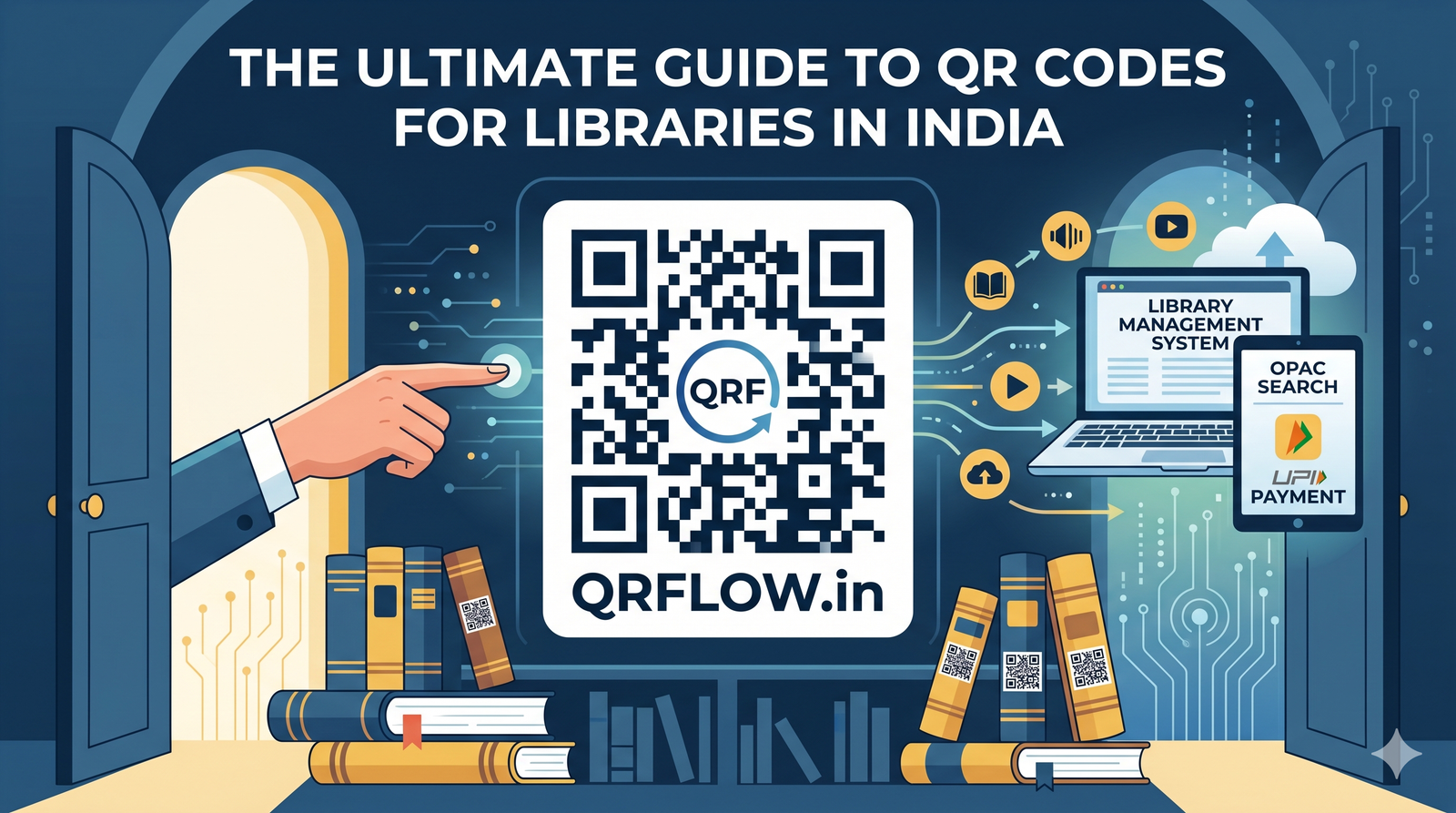
Imagine this: Your library in Bangalore just invested ₹50,000 in high-quality vinyl stickers for 2,000 new arrivals. Each sticker has a QR code pointing to the digital "OPAC" (Online Public Access Catalog) entry.
Two weeks later, you migrate your library management software to a new server. All those links are now dead. Every single sticker is a "404 Error" in a student's hand.
To fix this, you have to scrape off 2,000 stickers, redesign, and reprint. The cost? Another ₹50,000 plus weeks of manual labor. This is the "Static Mistake"—a nightmare that stops Digital India initiatives in their tracks.
Quick Summary
Modern Indian libraries are moving beyond just "storing books." They are becoming interactive hubs. By using Dynamic QR Codes, librarians can update content, track which genres are popular, and provide digital supplements—all without ever touching a printer again.
1. The Crisis of Static Signage in Indian Institutions
Most librarians start with free, "static" QR generators found on the web. While these seem "free," they are the most expensive choice a library can make.
In India’s humid climate, or under heavy use in college libraries in Delhi or Mumbai, physical labels have a lifespan. But the digital link shouldn't. Static codes hard-code the URL into the pixel pattern. If your library website moves from .com to .ac.in or .org, your entire physical inventory becomes obsolete.
The Cost of a Static Error:
- Reprinting: ₹5 to ₹15 per high-quality book label.
- Labor: 100+ man-hours to re-label a medium-sized collection.
- User Frustration: Students lose trust in digital library services.
2. Dynamic vs. Static: The Librarian’s Comparison
| Feature | Static QR Codes | Dynamic QR Codes (QRFlow) |
|---|---|---|
| Editability | Permanent. Cannot be changed. | Unlimited edits to the URL. |
| Data Tracking | Zero insights. | Track scans by City, Device, & Time. |
| Scan Reliability | Dense patterns; hard to scan if small. | Short URLs; scans instantly even when small. |
| Customization | Basic black and white. | Custom branding with library logos. |
| Bulk Management | Manual one-by-one creation. | Bulk generation for 1,000s of books. |
Pro-Tip: Always use Dynamic QR codes for "Shelf Talkers." If you move the "Science Fiction" section to a different floor, you can update the digital map link in 10 seconds on the QRFlow Dashboard.
3. 6 High-Impact Use Cases for Indian Libraries
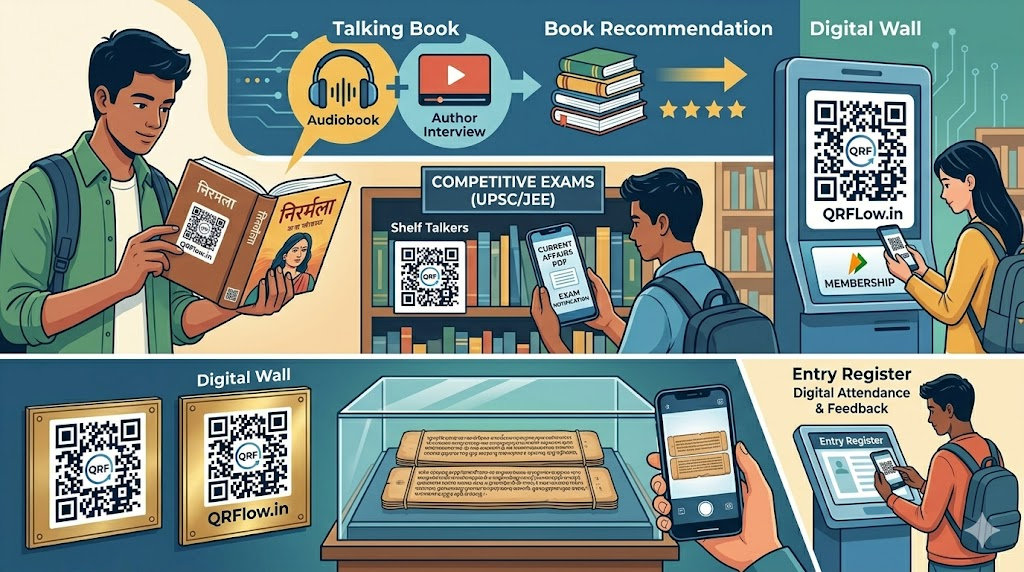
Case 1: The "Talking Book" (Multimedia Supplements)
Place a QR code on the inside cover of classic Hindi or regional literature. Link it to an audiobook version or a video interview with the author. This supports the National Education Policy (NEP) goals of multi-modal learning.
Case 2: Interactive "Shelf Talkers"
In the Competitive Exams section (UPSC, JEE, NEET), place QR codes that link to the latest "Current Affairs" PDF or "Exam Notification" page. Since these links change monthly, a Dynamic QR is the only way to keep the shelf relevant.
Case 3: Digital Attendance & Feedback
Replace the physical "Entry Register" at the gate. A QR code can lead to a simple Google Form or library portal. Use QRFlow Features to track peak entry times in your Mumbai or Hyderabad branch.
Case 4: Membership Renewals & UPI Payments
Stop the "Chutte Nahi Hai" (I don't have change) conversation. Link a QR code to your library’s payment gateway for fine collection or membership renewals via RBI-approved UPI.
Case 5: The "Digital Wall" for Rare Manuscripts
Many Indian libraries have rare manuscripts that can't be touched. Display a high-res QR code next to the glass case so students can "flip through" the digitized version on their smartphones.
Case 6: Book Recommendations (The Netflix Effect)
When a student finishes a popular novel like The White Tiger, a QR code on the last page can suggest "5 Similar Reads Available in our Library," increasing book circulation.
4. ROI Formula: Calculating Your Savings
How much does a library actually save by switching to QRFlow Pricing plans?
The Manual Cost (C):
C = (N x P) + (L x R)
- N: Number of Books (e.g., 5,000)
- P: Cost of Printing/Sticker (₹10)
- L: Hours of Labor (50 hours)
- R: Labor Rate (₹200/hr)
- Total: ₹60,000 per update.
The QRFlow Cost (C):
- Subscription: ~₹5,000/year (Pro Plan)
- Update Cost: ₹0 (Instant digital update)
- Total: ₹5,000.
Annual Savings: ₹55,000 per year for a single catalog update.
5. Compliance & Standards (DPDP & ISO)
In the era of the Digital Personal Data Protection (DPDP) Act 2023, Indian institutions must be careful with user data.
- ISO/IEC 18004: QRFlow generates codes following the international standard for QR Code 2005 symbology.
- Data Residency: QRFlow respects the privacy of Indian students. Unlike "shady" free generators, we don't sell scan data to third-party advertisers.
- Aatmanirbhar Tech: Using a platform designed for the Indian ecosystem ensures better support for local payment methods and regional languages.
6. Why QRFlow.in is the Top Choice for Libraries
While there are global players, QRFlow.in is optimized for the Indian SMB and Institutional sector:
- Bulk Generation: Upload a CSV of 5,000 book titles and get 5,000 unique Dynamic QR codes in seconds.
- Scan Analytics: See if your "Career Guidance" section is actually being used. Filter data by city or device type.
- Free Tier: We offer a "Free 3 QRs Forever" plan for small community libraries or "Mohalla Libraries" to get started.
- Branding: Add your University or School logo to the center of the QR code to prevent tampering and increase trust.
Ready to digitize? Create your first Library QR today.
7. Frequently Asked Questions (FAQs)
Q1: Can I use QR codes for book checkout?
Yes. You can link the QR code to your Library Management System's (LMS) specific book ID URL to facilitate self-checkout.
Q2: Will the QR code stop working if I stop my subscription?
On our paid plans, your codes remain active as long as the account is in good standing. We offer various tiers to fit even the smallest school budget.
Q3: Do students need a special app to scan?
No. Any modern smartphone camera (Android or iOS) can scan QRFlow codes natively.
Q4: Can I password-protect a QR code?
Yes, QRFlow allows you to add a password layer—perfect for "Exams Only" or "Staff Only" digital folders.
Q5: How do I handle 10,000 books?
Our Bulk Upload feature allows you to generate thousands of unique Dynamic QRs by simply uploading an Excel sheet.
Q6: Are the QR codes high-resolution for printing?
Absolutely. You can download them in SVG or Print-Quality PNG formats.
Q7: Can I track which hostel scans the most books?
If you use different QR codes for different physical locations, our analytics will show you exactly which location is most active.
Q8: Is there a limit on scans?
QRFlow offers generous scan limits designed for high-traffic environments like University libraries during exam season.
Quick-Start Checklist for Librarians
- [ ] Audit: Identify high-traffic sections (Reference, Careers, New Arrivals).
- [ ] Sign Up: Create a free account at app.qrflow.in.
- [ ] Test: Generate one Dynamic QR for your "Library Rules" PDF.
- [ ] Print: Download the high-res file and place it at the circulation desk.
- [ ] Analyze: Check the Features page to see how to read your scan data.
Author Bio:
The QRFlow Editorial Team consists of Digital Transformation consultants dedicated to empowering Indian SMBs and Educational Institutions. We focus on bridging the gap between physical assets and digital efficiency through "Phygital" innovation.